喓
Character Story & Explanation
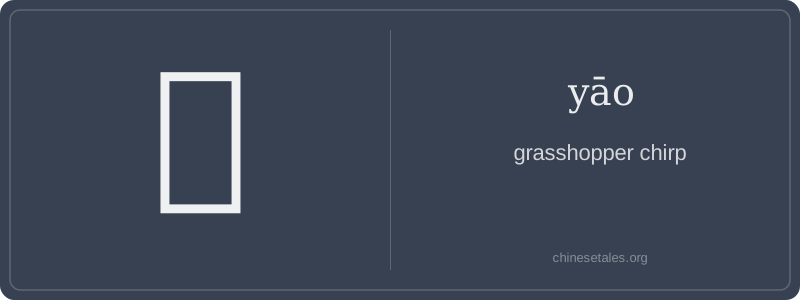
The character 喓 has no oracle bone or bronze script form — it’s a relatively late phonosemantic compound, first attested in Eastern Han dictionaries. Its left component 口 (kǒu, 'mouth') signals sound-related meaning, while the right side 幺 (yāo), originally a pictograph of a coiled thread or tiny thing (later simplified to two dots and a hook), provides both sound and semantic nuance: smallness, fineness, repetition. Over centuries, 幺 evolved from a curving line representing a thread’s twist into today’s compact three-stroke shape — and when fused with 口, the whole character visually whispers 'tiny sound from the mouth'.
This visual logic directly shaped its meaning: not just any insect noise, but the light, high-pitched, recurrent chirp of small orthopterans — especially crickets and grasshoppers. It appears prominently in the Shijing’s 'Cáo Fēng' section: '喓喓草蟲,趯趯阜螽' (yāo yāo cǎo chóng, tì tì fù zhōng) — describing grasshoppers chirping and locusts leaping — establishing 喓喓 as the canonical onomatopoeia for rural summer soundscapes. The character’s structure thus encodes both acoustic quality (via 口) and scale/texture (via 幺), making it a miniature masterpiece of phonosemantic design.
Think of 喓 (yāo) as Chinese onomatopoeia’s version of the cartoon 'boing!' — not a word you’d use to order dumplings, but the precise sonic brushstroke that paints a summer meadow at dusk. It doesn’t mean 'grasshopper' — it means *the sound* a grasshopper makes: a short, sharp, rhythmic chirp, like a tiny violin bow drawn across one string. In English, we might say 'chirp' or 'creak', but 喓 is far more specific — it’s the auditory fingerprint of orthopteran life in classical and literary Chinese.
Grammatically, 喓 is almost always reduplicated (喓喓) and functions as an adverbial modifier or standalone interjection — never as a noun or verb. You’ll hear it in descriptive passages, not conversations: '喓喓草虫' (yāo yāo cǎo chóng) — 'the grasshoppers chirp-chirp' — where the repetition mimics the insect’s staccato rhythm. Learners sometimes mistakenly treat it like a verb ('to chirp') and try to add aspect particles (e.g., 喓了), but it’s frozen in its reduplicated form — like English 'tick-tock', not 'tick'. It appears almost exclusively in poetic, lyrical, or highly stylized prose.
Culturally, 喓 carries pastoral nostalgia — evoking ancient fields from the Shijing (Book of Songs), where insect sounds signaled seasonal change and quiet longing. Modern speakers rarely use it outside literary imitation or children’s poetry; confusing it with common verbs like 叫 (jiào, 'to call') is a classic trap — 喓 isn’t loud or intentional; it’s delicate, automatic, and deeply embedded in China’s acoustic landscape of nature.