喈
Character Story & Explanation
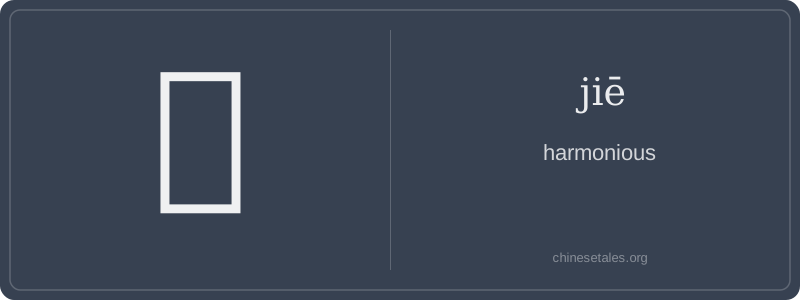
The earliest form of 喈 appears in bronze inscriptions as a compound: left side 口 (kǒu, ‘mouth’ or ‘sound’), right side 皆 (jiē, ‘all, altogether’ — itself composed of 亼 ‘gathering’ + 曰 ‘to speak’). In oracle bone script, 皆 depicted multiple mouths converging — literally ‘voices speaking as one’. Over centuries, the right side simplified from 皆 to its modern form, while 口 remained steadfastly on the left — a visual promise: harmony born from shared utterance, not silence.
This character wasn’t coined for philosophy — it was *heard*. In the Shījīng (c. 11th–7th BCE), 喈喈 describes the paired cries of cranes (‘the cranes cry 喈喈 in the marshes’ — Ode 184), signaling seasonal balance and moral order. Confucius praised such passages for their ‘pure tonal virtue’ — where sound itself embodied cosmic harmony. The character’s very structure — mouth + ‘all together’ — became a microcosm of early Chinese cosmology: harmony isn’t imposed, but emerges organically when voices align. No wonder it’s vanished from daily speech — its power lies in its rarity, like hearing a crane’s call at dawn.
First, let’s get the vibe right: 喈 (jiē) isn’t your everyday ‘harmonious’ — it’s poetic, archaic, and deeply sonic. It doesn’t mean ‘harmony’ in the abstract sense like 和 (hé), but specifically evokes *harmonious vocal resonance*: voices blending smoothly, birdsong in unison, or ancient court musicians playing in perfect accord. Think less ‘teamwork’ and more ‘a cappella choir hitting every note just so’. Its core feeling is acoustic unity — warm, balanced, almost tactile in its rhythmic flow.
Grammatically, 喈 is almost exclusively used as a reduplicative adverb (like 喈喈 jiē jiē) or in fixed classical compounds (e.g., 喈喈). You’ll rarely see it alone in modern speech — it’s not an adjective you’d say ‘this meeting was 喈’; instead, it modifies verbs descriptively: ‘they sang 喈喈’, ‘the cranes called 喈喈’. Learners often mistakenly treat it as a standalone adjective (like ‘harmonious’) — but it’s never used attributively before nouns (❌ 喈的音乐). It only lives in sound-rich, lyrical contexts.
Culturally, 喈 is a linguistic fossil from the Shījīng (Classic of Poetry), where it appears over a dozen times to describe auspicious bird calls — especially cranes — symbolizing virtue, peace, and heavenly approval. Modern usage is nearly limited to literary allusion, calligraphy, or poetic branding (e.g., a music studio named 喈鸣). A common mistake? Confusing it with 洁 (jié, ‘clean’) due to similar pronunciation — but they’re worlds apart in meaning and script. Remember: 喈 is about *sound*, not sanitation!