喃
Character Story & Explanation
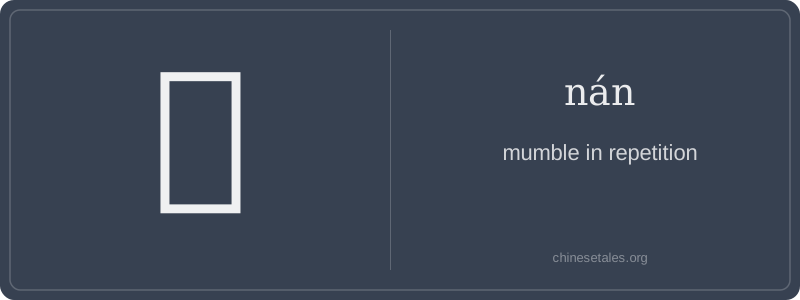
The earliest trace of 喃 appears not in oracle bones, but in late Han dynasty clerical script, where it emerged as a newly coined character to capture a specific auditory nuance. Its structure is deliberately synthetic: the left 口 was standard for speech characters, while the right 南 was borrowed solely for its pronunciation — a classic example of a phono-semantic compound (形声字). There’s no ancient pictograph; it was ‘designed’ rather than ‘discovered’. Stroke order reflects this logic: first the mouth (3 strokes), then the southern component (9 strokes), built from top to bottom — the dot above 十 becomes the ‘roof’ of 南, and the final horizontal stroke seals the lower part like a quiet exhalation.
By the Tang dynasty, 喃喃 had crystallized into its modern sense of hushed, repetitive utterance — appearing in Buddhist sutra translations where monks chanted mantras softly, and later in Song dynasty ci poetry to evoke solitude. Interestingly, 南 itself carries no directional meaning here; it’s pure sound mimicry. The character’s visual rhythm — two stacked mouths implied by the repetition — subtly reinforces its meaning: one mouth speaking, another echoing. This doubling isn’t literal, but perceptual: when you hear 喃喃, your ear hears layered softness, not geography.
Think of 喃 (nán) as the sound of a voice looping in quiet, private circles — not shouting, not singing, but murmuring under one’s breath, often with a rhythmic, almost hypnotic repetition. It’s onomatopoeic at heart: the 口 (kǒu, 'mouth') radical tells you it’s speech-related, while the right side 南 (nán, 'south') is purely phonetic — it gives the sound but zero meaning. So visually, it’s 'mouth + south' — yet semantically, it’s all about that soft, low, repetitive vocal hum, like someone rehearsing lines or calming themselves by whispering the same phrase over and over.
Grammatically, 喃 is almost always used in the reduplicated form 喃喃 (nánnán), functioning as an adverb or adjective to describe *how* speech happens — never as a standalone verb. You’ll see it after verbs like 说 (shuō, 'to say') or 念 (niàn, 'to recite'): 他喃喃自语 (tā nánnán zìyǔ, 'he mumbles to himself'). Crucially, it’s never used for loud, clear, or purposeful speech — if you write '她喃喃地读课文', native speakers will cringe; use 朗读 (lǎngdú, 'read aloud') instead. Learners often mistakenly treat it as a verb ('she nans') — but 喃 doesn’t conjugate, doesn’t take objects, and never stands alone.
Culturally, 喃喃 evokes intimacy, vulnerability, or mental preoccupation — think of a child soothing themselves, a scholar lost in thought, or someone grieving quietly. In classical poetry, it appears in melancholic contexts (e.g., Li Qingzhao’s works), where repetition mirrors emotional circling. A common mistake is overusing it in formal writing; it’s literary and slightly poetic, rarely found in news or business Chinese. Also, avoid confusing it with similar-sounding verbs like 难 (nán, 'difficult') — tone and context are your only guides here.