喁
Character Story & Explanation
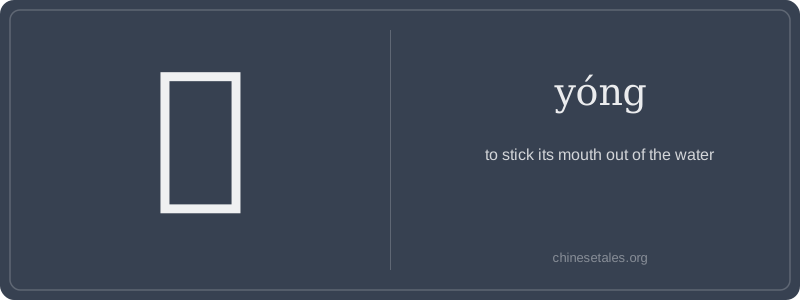
The earliest trace of 喁 appears not in oracle bone script but in Han dynasty seal script, where it was composed of two 口 (mouth) radicals stacked vertically over 大 (a simplified figure of a person) — later evolving into the modern form with two 口 side-by-side atop 禾 (originally representing a stalk, but here acting phonetically). By the Six Dynasties period, the top evolved into 禾 + 一, then standardized as 禾 with a horizontal stroke, while the twin 口 remained — visually echoing the image of multiple mouths rising together from water. The 12 strokes map this duality: four strokes for each 口 (8), plus four for the upper 禾-like component (禾 is 5 strokes, but here simplified to 4).
This character first surfaced in the 3rd-century text Shuō Yuàn (Garden of Stories), describing fish ‘喁喁然出水’ — mouths softly emerging ‘thusly’. Over centuries, its meaning subtly broadened: from literal aquatic behavior to metaphorical ‘soft collective utterance’, especially in intimate or secretive contexts. The twin 口 are key — they don’t mean ‘two mouths’, but ‘many mouths moving as one’, evoking unity, gentleness, and quiet resonance. That’s why classical poets paired it with words like ‘细语’ (whisper) or ‘相呼’ (calling softly to one another): it’s never loud, never solitary — always shared, surface-level, and serene.
Imagine a school of fish gently breaking the water’s surface — not leaping, not splashing, but softly parting the ripples with their mouths just peeking above: that’s the quiet, poetic essence of 喁 (yóng). It’s not a loud or forceful action; it’s delicate, rhythmic, almost meditative — like synchronized breathing at the water’s edge. This character carries a distinctly literary, even classical, aura; you’ll almost never hear it in daily conversation, and it’s absent from all HSK lists because modern Mandarin prefers verbs like ‘探出’ or ‘浮出’. Its core feel is visual and onomatopoeic — the repeated 口 radicals evoke the soft, bubbling sound of many mouths opening and closing in unison.
Grammatically, 喁 functions as an intransitive verb, usually appearing in reduplicated form 喁喁 (yóng yóng) to emphasize collective, gentle movement or murmuring — whether of fish surfacing or people whispering intimately. You’ll see it in phrases like ‘喁喁细语’ (whispering softly), where the doubled form mimics both sound and motion. Learners often mistakenly treat it as a standalone verb meaning ‘to speak’, but it *never* appears alone in standard usage — always doubled or embedded in fixed literary expressions.
Culturally, 喁 belongs to the elegant, sensory-rich vocabulary of classical poetry and early vernacular fiction. It’s a ‘quiet luxury’ character — valued for its precision and atmosphere, not utility. A common pitfall is mispronouncing it as yōu or yǔ — remember: yóng rhymes with ‘song’ and carries the rising tone, mirroring the upward motion of mouths emerging. And yes — though rare, 喁 *can* be read yú in ancient phonetic loan contexts (e.g., in some Tang dynasty rhyme tables), but for all practical purposes, yóng is the only pronunciation you’ll ever need.