喀
Character Story & Explanation
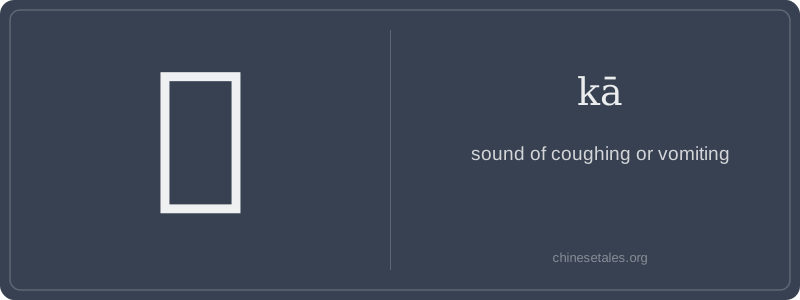
The earliest trace of 喀 lies not in oracle bones but in late Warring States bronze inscriptions and early seal script, where it emerged as a compound: 口 (kǒu, 'mouth') on the left, plus 客 (kè, 'guest') on the right—but crucially, 客 was used here *phonetically*, not semantically. In ancient pronunciation, 客 sounded close to *kā*, making this a classic 'semantic-phonetic' character (形声字): 口 signals the mouth/sound domain, 客 provides the sound clue. Visually, the modern 12-stroke form preserves that logic—the left radical 口 is compact and upright, while the right side 客 evolved from a more pictorial 'roof over person' into today’s stylized strokes (宀 + 各), now abstract but still echoing its phonetic role.
This character didn’t exist in Classical Chinese texts—it’s a relatively late innovation, gaining traction in Ming-Qing vernacular fiction and 20th-century literature. You won’t find 喀 in the Shuōwén Jiězì, but you *will* spot it in Lao She’s gritty Beijing dialogues or Jin Yong’s wuxia scenes, where sound authenticity mattered more than literary decorum. Its visual duality—mouth + guest—ironically mirrors its function: a 'guest' sound bursting uninvited from the mouth!
Imagine you’re in a quiet Beijing teahouse when suddenly—kā!—a sharp, guttural cough cuts through the steam and clink of porcelain. That’s 喀: not a word describing the illness, but the raw, involuntary *sound* itself—like a pebble rattling in a tin can or phlegm bursting free. It’s purely onomatopoeic, carrying no grammatical weight as a verb or noun on its own; instead, it functions as an interjection or reduplicated sound (喀喀) to evoke immediacy and physicality.
Grammatically, 喀 almost always appears reduplicated (喀喀) or paired with other sound characters (e.g., 咳喀, 喀啦), rarely standing alone. You’ll hear it in descriptive writing—not in daily speech—and almost never in formal contexts. Learners mistakenly treat it like 咳 (hāi, 'to cough') and try to conjugate it ('I 喀ed yesterday'), but 喀 has no verb form. It’s frozen in sound: a sonic snapshot, not an action.
Culturally, 喀 belongs to a subtle class of ‘low-register’ onomatopoeia—associated with bodily discomfort, roughness, or even comic indignity. It’s common in martial arts novels (a villain spits blood with a 喀!) or satirical essays mocking pretentious speakers who clear their throats *too* dramatically. Unlike English ‘cough’, which is neutral, 喀 implies abruptness, lack of control, and often a faintly unrefined edge—so avoid it in polite letters or medical reports!