啽
Character Story & Explanation
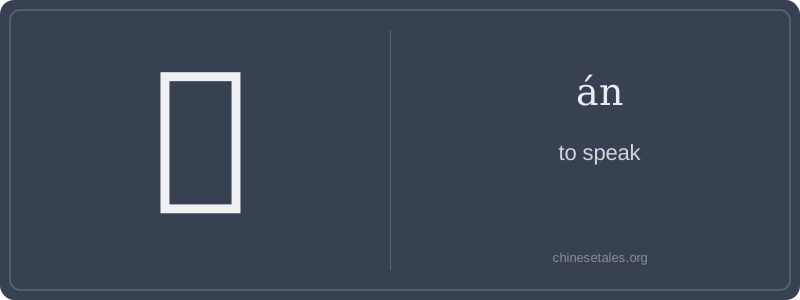
The character 啽 doesn’t appear in oracle bone or bronze inscriptions—it’s a latecomer, born in the Ming–Qing transition as a phonetic-semantic compound. Its left side 口 (kǒu, 'mouth') signals speech-related meaning, while its right side 含 (hán, 'to hold in mouth; to contain') provides both sound (hán → án via dialectal softening) and imagery: lips slightly parted, holding a soft syllable—not shouting, but *containing* speech before release. Visually, it’s a mouth cradling a whispered vowel, with 含’s 'today' (今) and 'mouth' (口) components nested inside, now simplified into a flowing, open shape.
By the late Qing, 啽 surfaced in vernacular novels and Sichuan opera scripts as a transcription of local interjections—akin to English 'um...', 'well...', or 'ah...'. Unlike classical characters tied to ritual or morality, 啽 emerged from lived speech: farmers pausing mid-sentence, elders softening directives, lovers hesitating before confession. It appears in Li Baojia’s satirical novel Officialdom Unmasked (1903) as a marker of provincial authenticity, and later in Ba Jin’s Sichuan-rooted works, where it subtly signals class, region, and emotional restraint—never written, always *sounded*.
Imagine you’re eavesdropping on a late-night conversation in an old Sichuan teahouse—steam rising, bamboo chairs creaking—and suddenly someone murmurs, 'Ān… nǐ shuō de duì.' That soft, thoughtful, almost breathy 'ān' isn’t just agreement—it’s 啽: a gentle, hesitant, spoken utterance, like the first syllable of a sentence still forming in the mind. It doesn’t mean 'to speak' in the bold, declarative sense (that’s 说 shuō); 啽 is quieter, more intimate—like murmuring to yourself, testing an idea aloud, or softly prompting someone else.
Grammatically, 啽 functions almost exclusively as an interjection or modal particle, usually at the start or middle of speech, often with a trailing ellipsis or pause in writing. You’ll see it in regional literature (especially Sichuanese and Hunanese dialect fiction) or stylized dialogue: 'Ān… wǒ xiǎng yí xià.' It’s never used as a verb ('to speak') in modern standard Mandarin—so if you try to say 'tā zài ān' meaning 'he is speaking', you’ll confuse native speakers entirely. It’s not a dictionary verb; it’s a vocal gesture.
Culturally, 啽 captures a uniquely Southern Chinese conversational rhythm—hesitant, reflective, warm, and deeply oral. Learners often misread it as a variant of 安 (ān, 'peace') or 按 (àn, 'to press'), but neither fits phonetically or functionally. Its rarity in formal writing means it’s rarely taught—but when it appears, it adds texture, authenticity, and regional flavor. Think of it as punctuation with a voice: not a word you *use*, but one you *recognize* to hear the speaker’s tone.