啼
Character Story & Explanation
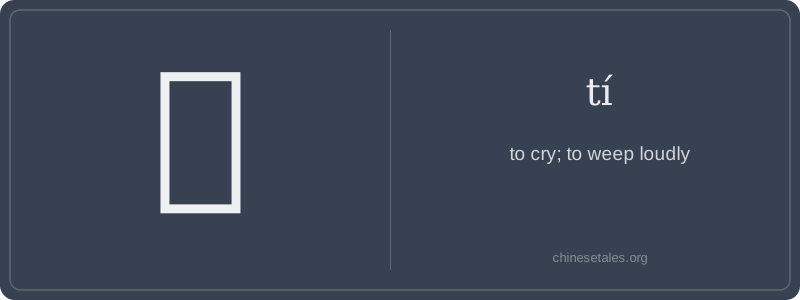
The earliest form of 啼 appears in bronze inscriptions as a combination of 口 (mouth) and 帝 (a phonetic component, originally depicting a ceremonial headdress or divine authority). By the Warring States period, the character stabilized: left side 口 (radical, signaling speech/sound), right side 帝 — not for ‘emperor’, but as a *sound clue* (both 啼 and 帝 share the ‘-i’ rhyme and were historically close in pronunciation). The 12 strokes map neatly: 3 for 口, then 9 for 帝 — including the distinctive horizontal stroke at the top, the crossbar, and the final downward hook — all evolving to emphasize vocal intensity rather than imperial power.
Meaning-wise, 啼 began as a specific verb for ‘birds calling loudly’ (e.g., in the Shijing, ‘鶴鳴于九皋,聲聞于野’ — cranes cry in distant marshes), then broadened to include humans in high-emotion contexts: mourning, childbirth, or ritual lamentation. Unlike 哭 (general weeping), 啼 retained its association with *pitch*, *resonance*, and *natural expression* — hence its enduring use in poetry and classical allusion, where sound itself becomes metaphor. Its visual duality — mouth + ‘divine’ phonetic — subtly reinforces how ancient Chinese saw vocalization as both biological and spiritually charged.
Imagine a moonlit courtyard in ancient Chang’an: a lone scholar sits beneath a willow, his inkstone dry, his poem unfinished — until a sudden, piercing tí splits the silence. Not a sob, not a whimper, but a raw, open-throated cry — like a startled crane or a grieving widow wailing at a tomb. That’s 啼: it’s never quiet tears or silent sorrow; it’s vocal, visceral, and often animal or ritualistic. It carries weight — think of classical poetry where ‘cranes 啼 at dusk’ signals autumnal melancholy, or ‘infants 啼’ implies urgent, unfiltered need.
Grammatically, 啼 is almost always a verb, used in literary or poetic registers (rare in daily spoken Mandarin — learners won’t hear it on subway announcements!). It pairs naturally with subjects that *produce sound from the mouth*: birds (鸟啼), infants (婴啼), monkeys (猿啼), even wind ‘crying’ through cracks (风啼 — poetic personification). You’d say ‘夜半猿啼’ (yè bàn yuán tí), not ‘yè bàn yuán kū’ — because 啼 evokes timbre and resonance, while 哭 is general human weeping. Don’t force it into modern colloquial sentences like ‘I cried yesterday’ — that’s 哭, not 啼.
Culturally, 啼 appears in idioms like ‘杜鹃啼血’ (dù juān tí xuè) — ‘the cuckoo cries blood’, referencing a mythical bird that sings until its beak bleeds, symbolizing undying loyalty or tragic devotion. Learners often misread 啼 as ‘tī’ (like 梯) or confuse it with 帝 (emperor) — but its true power lies in its sonic authenticity: it doesn’t just mean ‘cry’ — it *sounds* like crying when you say it aloud: ‘tí’ has that sharp, rising, breathy release — like an involuntary gasp turning into a wail.