啵
Character Story & Explanation
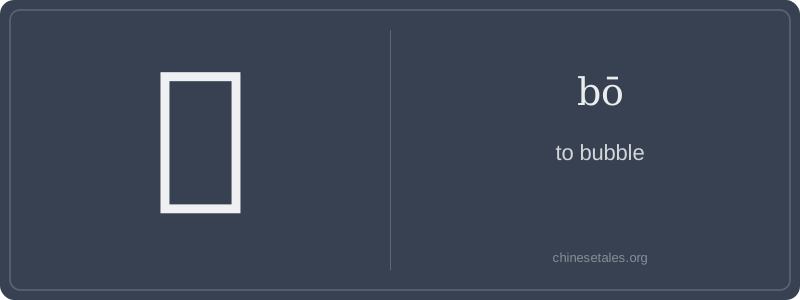
The earliest trace of 啵 isn’t in oracle bones, but in later phonetic-semantic compound formation. Its left radical 口 (kǒu, ‘mouth’) signals its domain: speech, sound, vocalization. The right side is 波 (bō, ‘wave’), borrowed here purely for its sound — not its meaning. So 啵 was born around the Han dynasty as a *phonetic loan character*: scribes needed a way to write the bubbling sound, and since 波 already sounded like ‘bo’, they paired it with 口 to anchor it in the realm of audible expression. Visually, the 11 strokes flow — three horizontal lines in 口 (like lips parting), then 波’s undulating 氵 (three-dot water) plus ‘皮’ (pí, ‘skin’ — hinting at the thin, bursting surface of a bubble).
Over centuries, 啵 shed classical formality and settled into vernacular life. Unlike many characters that grew abstract, 啵 stayed stubbornly sensory — appearing in Ming-dynasty storybooks describing ‘fèi bo’ (boiling-bo) in teakettles, and Qing-era folk ballads mimicking the ‘pū bo’ of steam escaping bamboo steamers. Its visual link to 波 is ironic: 波 evokes wide, rolling ocean swells, while 啵 captures tiny, fleeting, upward-popping micro-events — a delightful semantic twist baked into its structure.
Think of 啵 not as a dictionary definition, but as a sonic fingerprint — it’s the *sound* of bubbles rising and popping: soft, rhythmic, slightly fizzy. In Chinese, it’s almost never used alone; instead, it’s a vivid onomatopoeic particle tacked onto verbs or adjectives to add tactile, bubbly energy — like sprinkling effervescence into speech. You’ll hear it in spoken Mandarin, especially in northern dialects and informal storytelling: ‘gǔn bo’ (roll-bo!) doesn’t just mean ‘roll’ — it means ‘roll *with little bursts*, like marbles down a bumpy tile floor’.
Grammatically, 啵 is a sentence-final or verb-modifying particle — never a standalone verb or noun. It’s tone-dependent: pronounced bō (first tone) when imitating bubbling (e.g., ‘fú bo’ — bubbles rise), but often reduced to neutral tone ‘bo’ in rapid speech or as an emphatic, almost teasing tag (‘nǐ kàn bo!’ — ‘look, see?’, with playful insistence). Learners mistakenly treat it like a verb (trying to say ‘I bubble’) — but 啵 doesn’t *do* the action; it *colors* it. It’s the difference between saying ‘the water boils’ and saying ‘the water *glugs, plops, shushes* as it boils’.
Culturally, 啵 belongs to the rich world of Chinese sound symbolism — where characters aren’t just meaning-carriers, but *sound-actors*. It appears in folk songs, children’s rhymes, and regional opera to evoke liveliness and lightness. A common error? Confusing it with 波 (bō, ‘wave’) — same pronunciation, but 波 is a noun about water movement; 啵 is pure auditory texture. Also beware: 啵 rarely appears in formal writing — it’s oral, intimate, and deeply colloquial.