啲
Character Story & Explanation
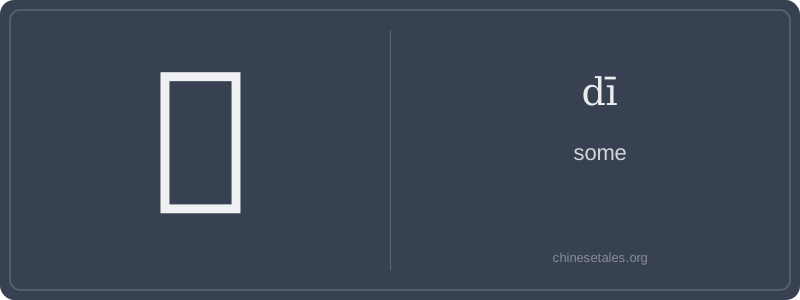
Here’s the surprise: 啲 has *no oracle bone or bronze script ancestry*. It doesn’t appear in any pre-Qin inscriptions because it didn’t exist yet—it’s a late, vernacular innovation. Its form emerged during the Ming–Qing period as a cursive, handwritten simplification of the character 些 (xiē), meaning 'some' or 'a few'. Scribes writing quickly in southern China began collapsing 些’s upper part (此) and lower part (二+儿) into a fluid, single-unit glyph: the left side evolved into 口 (kǒu, 'mouth')—not for meaning, but as a convenient, closed-loop placeholder—and the right side became the slanted, minimalist 丁 (dīng), borrowed purely for its sound. This wasn’t etymology—it was handwriting pragmatism.
The meaning stayed anchored to 些, but 啲 absorbed Cantonese phonology and syntax, becoming the go-to colloquial quantifier by the 19th century. Unlike 些, which remains literary and pan-dialectal, 啲 thrived only where Cantonese was spoken—Canton, Hong Kong, Macau—and gained cultural weight as a marker of regional authenticity. Classical texts never used it; even early 20th-century dictionaries labeled it 'vulgar writing'. Yet today, it’s ubiquitous in Hong Kong signage, subtitles, and social media—proof that linguistic authority often rises from the street, not the academy.
Here’s the twist: 啲 (dī) isn’t Standard Mandarin at all—it’s a Cantonese grammatical particle meaning 'some' or 'a bit', used exclusively in spoken (and informal written) Cantonese. It’s not a standalone word like 一些 (yīxiē), but a soft, colloquial quantifier that clings to nouns—like adding 'a few' or 'some' with a wink. You’ll hear it after measure words or nouns: ‘幾啲’ (gāi dī, 'a few'), ‘啲水’ (dī shuǐ, 'some water'). Crucially, it *never* appears in formal writing, textbooks, or Putonghua contexts—so if you write 啲 in a Beijing essay, your teacher will blink in confusion.
Grammatically, 啲 is a pluralizing/quantifying particle attached to the *end* of noun phrases—unlike Mandarin’s 一些, which precedes the noun. So while Mandarin says 'yǒu yīxiē rén' (there are some people), Cantonese says 'hai5 jau5 dī jan4' (there are some people), with 啲 right before the noun. Learners often misplace it (e.g., saying *dī gè rén* like Mandarin’s *yīxiē gè rén*), but in Cantonese, it’s simply 'dī jan4'—no measure word needed. And yes, it’s pronounced with a low-falling tone (5th tone in Jyutping), not the Mandarin dī (1st tone).
Culturally, 啲 is the linguistic equivalent of a relaxed shrug—it signals informality, warmth, and local identity. Overusing it in formal Cantonese speech (like a business meeting) sounds unpolished; skipping it in casual chats with friends sounds stiff or overly academic. A classic mistake? Assuming it’s interchangeable with Mandarin 的 (de)—but they’re worlds apart: one marks possession, the other quantifies. Also, beware: 啲 looks deceptively simple, but its zero-stroke status reflects its origin as a *cursive shorthand*, not an ancient character—making it a fascinating artifact of living language evolution, not classical script.