啱
Character Story & Explanation
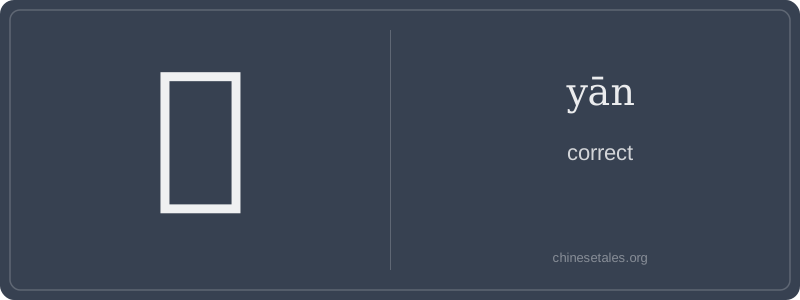
Here’s the twist: 啱 has no oracle bone or bronze script ancestry—because it doesn’t exist in classical literary Chinese at all. It’s a late, vernacular creation, born from Cantonese phonetic borrowing and semantic innovation. Its form combines 口 (kǒu, ‘mouth’, signaling speech/function) and 岸 (àn, ‘bank/shore’, used here purely for sound—yān). Visually, it looks like ‘mouth + shore’, but historically, it emerged around the Ming–Qing period as scribes adapted characters to write spoken Cantonese accurately—choosing 岸 for its yān pronunciation and adding 口 to mark it as a spoken particle.
The meaning evolved precisely because Cantonese needed a word that did what Mandarin’s 对 couldn’t: affirm not just factual correctness, but contextual appropriateness—‘this fits *just so*’. In early Cantonese opera scripts and street pamphlets, 啱 appears as a pragmatic marker of consensus, like nodding while listening. Unlike classical characters shaped by ritual or cosmology, 啱 was forged in teahouses and markets—its ‘shore’ isn’t geographical, but metaphorical: the safe, agreed-upon ground where speaker and listener meet.
Let’s get real: 啱 (yān) isn’t in standard Mandarin—it’s a Cantonese character, and that changes everything. To English speakers expecting textbook Chinese, 啱 feels like finding a secret door in a familiar building. Its core meaning is ‘correct’, ‘right’, or ‘exactly so’—but it carries the warmth of agreement, the snap of confirmation, and sometimes even gentle insistence. Think of it as Cantonese’s version of ‘bingo!’ or ‘spot on!’—not cold logic, but human resonance.
Grammatically, 啱 shines as a sentence-final particle (like 呀 or 吧 in Mandarin), but with sharper precision. You’ll hear it after statements to confirm shared understanding: ‘你係學生,啱?’ (nǐ haih xuéshēng, yān?) — ‘You’re a student, right?’ It can also modify adjectives (e.g., 啱啱好 — ‘just right’) or verbs (e.g., 啱聽 — ‘hear correctly’). Crucially, it’s never used in formal writing or Putonghua speech—so using it in Beijing will earn you puzzled smiles, not praise.
Culturally, 啱 embodies Cantonese linguistic confidence: concise, context-rich, and unapologetically local. Learners often mistakenly treat it as interchangeable with Mandarin 对 (duì) or 是 (shì)—but 啱 isn’t about truth-value; it’s about alignment, fit, and interpersonal attunement. Misuse usually comes from overgeneralizing its function or importing it into Mandarin contexts. Remember: 啱 lives in Hong Kong, Guangdong, and diaspora kitchens—not in HSK textbooks.