啐
Character Story & Explanation
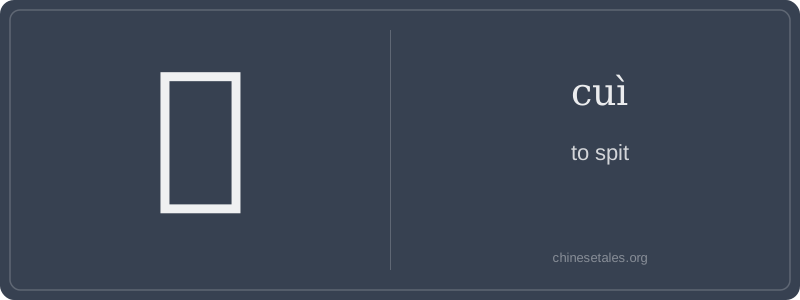
The earliest form of 啐 appears in Warring States bamboo slips as a compound pictograph: 口 (mouth) + 氐 (dǐ, originally a kneeling figure with emphasis on the base, later simplified). The mouth radical was clear, while 氐 conveyed ‘downward force’—not just direction, but *intentional expulsion*. Over centuries, 氐 evolved into 卒 (zú), losing its kneeling posture but keeping its sense of abrupt completion. By the Han dynasty, the character stabilized as 口 + 卒, visually echoing a mouth *finishing* an action decisively—hence the meaning ‘spit out sharply, once, with finality.’
This visual logic shaped its semantic path: from literal spitting (in oracle bone divination records where spittle marked rejected omens) to metaphorical rejection—‘spit on’ a proposal, ‘spit out’ a lie. In the *Zuo Zhuan*, 啐 appears in a diplomatic insult: ‘He 啐’d the treaty and tore the scroll.’ Here, the character isn’t about saliva—it’s about *performative refusal*. Its shape—11 strokes, compact yet jagged—mirrors the sudden recoil of lips and tongue, making it one of Chinese script’s most sonically embodied characters.
Imagine a dusty Ming-dynasty teahouse where an old scholar, furious at a corrupt official’s lie, suddenly spits—*cuì!*—a sharp, contemptuous jet of saliva onto the floorboards. That’s 啐: not just ‘to spit’ as a biological reflex, but a theatrical, visceral act of disgust, dismissal, or scorn. It’s emphatic, abrupt, and emotionally charged—never neutral. You won’t hear it in polite dinner conversation; you’ll hear it in opera, classical novels, or heated arguments when someone wants to *physically eject* falsehood or insult.
Grammatically, 啐 functions almost exclusively as an interjection or verb in imperative or narrative past tense—not as a standalone noun or adjective. It rarely takes objects (*not* ‘spit something’), and never appears in formal writing or modern spoken Mandarin outside literary or performative contexts. Learners mistakenly try to use it like 吐 (tǔ, ‘to vomit/spit out’) or 咳 (ké, ‘to cough’), but 啐 has no medical or habitual connotation—it’s purely expressive, often followed by silence or a glare. Its tone is always falling (cuì, 4th), matching its percussive, dismissive energy.
Culturally, 啐 carries echoes of ritual purification—spitting to ward off evil—and Confucian disdain for hypocrisy. In *The Scholars* (Rulin waishi), characters utter 啐 before denouncing moral failure. Modern learners overuse it thinking it’s ‘cool slang,’ but native speakers may find it jarringly archaic or aggressive—like shouting ‘Fie!’ in English. Use only when channeling righteous indignation in storytelling, drama, or historical reenactment—not your WeChat chat.