啎
Character Story & Explanation
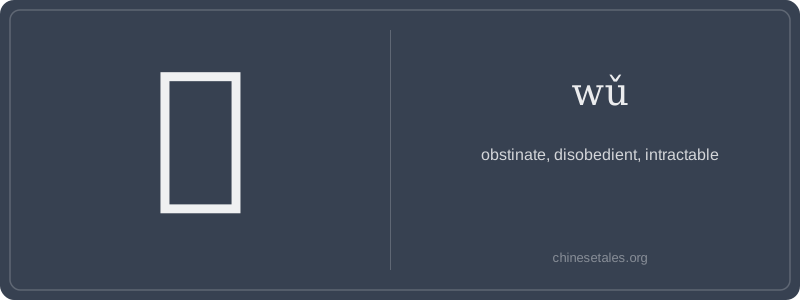
The earliest form of 啎 appears on Warring States bamboo slips as a compound ideograph: the left side was 口 (kǒu, ‘mouth’) — representing speech or command — and the right side was 吾 (wú, ‘I/me’), but written with a distinctive slanted stroke suggesting *pushing back*. Over time, the 口 shrank and shifted upward, while 吾 simplified: its upper part (五 wǔ) became the top component, and the lower part (口) merged visually with the original left 口, creating the illusion of two mouths stacked — a brilliant visual pun for ‘mouth clashing with mouth’, i.e., verbal defiance. By the Han dynasty, the shape stabilized into today’s 啎: two ‘mouths’ (the top 五 + bottom 口) locked in opposition.
This duality shaped its meaning from day one: not general disobedience, but *reciprocal, face-to-face resistance* — like a subordinate answering back, not just ignoring orders. The Zuo Zhuan uses 啎 in passages describing ministers who ‘utter words that 啎 the ruler’s intent’ — highlighting its link to spoken contradiction. Even today, 啎 implies active, vocal opposition, not passive noncompliance. Its rarity in modern speech isn’t due to obscurity, but precision: Chinese has dozens of ‘disobey’ words, but 啎 is the only one built from *two mouths fighting*, making it uniquely visceral and literarily potent.
Think of 啎 (wǔ) as the linguistic equivalent of crossing your arms and saying 'Nope' — not just disobedient, but *stubbornly* so. It’s a high-register, literary word that conveys deep-seated resistance: not mere refusal, but an almost physical tension against authority, logic, or expectation. You won’t hear it in casual chat — it’s for essays, classical allusions, or sharp literary critique. Its tone is heavy, slightly archaic, and emotionally charged — like calling someone ‘intractable’ instead of just ‘difficult’.
Grammatically, 啎 almost always appears as a verb meaning ‘to defy’ or ‘to go against’, and it’s nearly always transitive — it needs an object. You’ll see it in structures like ‘与…相啎’ (yǔ… xiāng wǔ, ‘to clash with…’) or ‘啎逆’ (wǔ nì, ‘to rebel against’). Crucially, it’s never used alone as an adjective — you wouldn’t say ‘他很啎’ (‘He is very wǔ’); instead, you’d say ‘他对命令啎抗’ (‘He defiantly resists orders’). Learners often misplace it as a standalone descriptor, like confusing ‘obstinate’ with ‘obstinately’ — a subtle but critical grammatical slip.
Culturally, 啎 carries Confucian weight: it evokes the dangerous boundary between healthy dissent and moral insubordination. In classical texts, using 啎 implies the defiance is *wrong*, not just inconvenient — it’s the word you’d use for a minister who contradicts the emperor’s virtuous decree, not a teen arguing about bedtime. That moral gravity means modern writers deploy it deliberately, often ironically or satirically — making it a stealthy tool for tone and subtext. Don’t reach for 啎 when ‘不听’ (bù tīng) will do; save it for moments where resistance feels fateful, not frivolous.