啄
Character Story & Explanation
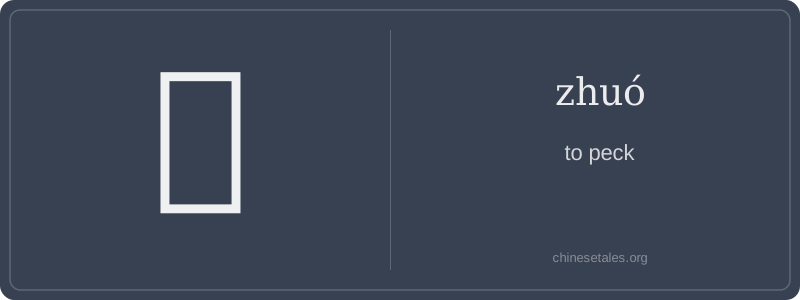
The earliest form of 啄 appears in bronze inscriptions as a combination of 口 (mouth/beak) and 豕 (shǐ, ‘pig’) — but wait! That’s misleading. Scholars now agree the right-hand component evolved from an ancient pictograph of a *bird’s head and beak extended forward*, stylized over centuries into today’s 丿 + 一 + 丶 + 一 shape — not 豕 at all. The left 口 radical was added later to emphasize the oral/feeding action. By the seal script era, the beak had become a sharp, downward-hooking stroke (the top 丿), and the lower part solidified into the ‘hand-like’ shape (勹 + 一 + 丶) representing the thrusting motion — 11 strokes total, each echoing the snap-and-retract rhythm of pecking.
This visual logic held firm across millennia. In the *Zuo Zhuan*, 啄 describes sparrows relentlessly 啄其屋瓦 (zhuó qí wū wǎ) — ‘pecking at their roof tiles’ — a sign of ill omen. By Tang poetry, Du Fu used 啄 to evoke fragility and persistence: ‘雏莺 啄新绿’ (chú yīng zhuó xīn lǜ) — ‘nestling orioles peck at fresh green’, where 啄 isn’t hunger, but life testing its first contact with the world. Even today, the character’s shape — a mouth leaning aggressively rightward — visually *leans into* its object, embodying directed, purposeful impact.
At its heart, 啄 is the sound and motion of a beak striking — sharp, rhythmic, precise. It’s not just ‘eat’ or ‘bite’: it’s the *tapping* action unique to birds: a woodpecker drilling into bark, a chicken pecking at grain, a heron stabbing at water. Native speakers feel its onomatopoeic grit — the ‘zhuó’ sound itself mimics that quick, hard *tok!* of keratin on surface. Unlike generic verbs like 吃 (chī, ‘to eat’) or 咬 (yǎo, ‘to bite with teeth’), 啄 is strictly avian and strictly *pointed*, directional, and repetitive.
Grammatically, 啄 is almost always transitive and often appears in vivid descriptive contexts — especially in literature, poetry, and nature writing. You’ll rarely hear it in casual speech (hence its absence from HSK), but you’ll see it in phrases like 啄食 (zhuó shí, ‘to peck for food’) or 啄木鸟 (zhuó mù niǎo, ‘woodpecker’ — literally ‘peck-wood-bird’). Learners sometimes overgeneralize it to mean ‘eat’ broadly, but using 啄 for a person eating would sound absurdly zoological — like saying ‘he *pecked* his dumpling’ in English. Also, note: it’s never used for human speech or singing — that’s 啜 (chuò) or 吟 (yín), not 啄.
Culturally, 啄 carries quiet precision — think of the Confucian ideal of ‘measured action’. In classical texts, it appears in metaphors for persistent, focused effort: a scholar ‘pecking’ at a difficult text line by line. A common mistake? Confusing it with 琢 (zhuó, ‘to polish jade’) — same pronunciation, similar stroke count, but utterly different radical and meaning. One is beak-on-wood; the other is chisel-on-stone.