啁
Character Story & Explanation
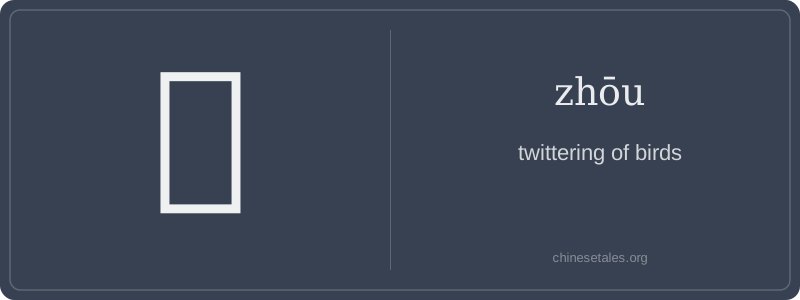
The earliest form of 啁 appears in Han dynasty seal script, where it already combined 口 (kǒu, 'mouth') on the left with 周 (zhōu, 'to encircle; complete') on the right. The 口 was stylized as a small square, representing the beak opening and closing rhythmically — not a static mouth, but a pulsing aperture. The right side 周 originally depicted a field with a boundary marker (◎ + 冂), evolving into a symbol of cyclical repetition — perfectly mirroring the looping, recurring cadence of bird calls. Over centuries, the strokes simplified: the top of 周 lost its circular enclosure, the lower part became 凡-like, and the whole character settled into its current 11-stroke balance — five strokes in 口, six in 周.
This visual duality — mouth + cyclical repetition — crystallized its meaning early. In the Wen Xuan (6th c. CE), 啁 appears in a poem describing ‘morning sparrows 啁啾 at the eaves’, linking the character to auspicious, peaceful dawn sounds. By the Tang dynasty, poets like Wang Wei used 啁 to evoke stillness through contrast: a single, precise bird sound amplifying silence. Even today, 啁 doesn’t just describe noise — it implies a natural, self-contained musical phrase, one that needs no audience to be meaningful. Its shape, then, is not a picture of a bird, but a diagram of how sound breathes: in-and-out, round-and-round, gentle and complete.
Think of 啁 (zhōu) as the Chinese onomatopoeic whisper of a bird’s morning gossip — not loud or harsh like 啼 (tí, to cry out), but light, rhythmic, and intimate: a soft, staccato twittering you’d hear from sparrows hopping along a sun-warmed tile roof. Its core feeling is delicate auditory texture, evoking not just sound but mood — tranquility, springtime, quiet observation. It’s almost exclusively used as a verb in literary or poetic contexts, never in casual speech or HSK-level materials, which is why learners rarely encounter it — yet it appears beautifully in classical poetry and modern nature writing.
Grammatically, 啁 is almost always paired with 啁啾 (zhōu jiū) — a reduplicated compound that strengthens the sense of continuous, gentle chirping. You’ll see it as a standalone verb in phrases like 啁啾不息 (zhōu jiū bù xī, 'twittering without cease'), or as a verb-object construction: 啁啾着 (zhōu jiū zhe, 'twittering away'). Unlike more general verbs like 叫 (jiào, 'to call'), 啁 carries no emotional urgency — it never means 'shout' or 'scream'; misusing it for human speech (e.g., *他啁着说话*) is a classic error. It belongs solely to birds, breeze, and poetic sensibility.
Culturally, 啁 embodies the Daoist and literati appreciation for subtle natural sounds — the kind that signal harmony, not alarm. In classical texts like the Shuōwén Jiězì, it’s defined as 'the fine, repeated sound of small birds', underscoring its association with delicacy and repetition. Learners sometimes overextend it to insects or wind, but native usage reserves it almost exclusively for passerine birds (sparrows, warblers, finches). Also beware: its radical 口 (mouth) might tempt you to think it's about human vocalization — but here, 口 represents the *source* of sound, not the speaker’s intent. It’s the bird’s beak, not a person’s voice.