唿
Character Story & Explanation
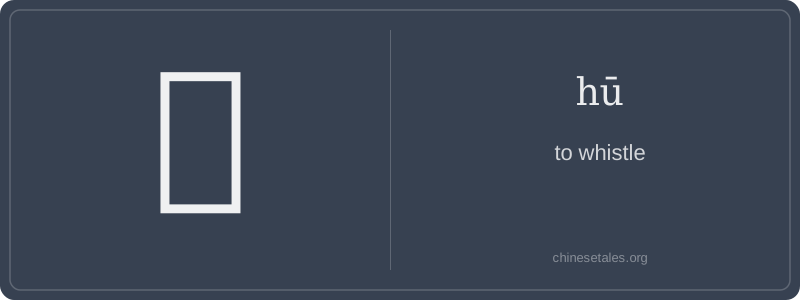
The earliest form of 唿 isn’t found in oracle bones, but emerged clearly in seal script (c. 3rd century BCE) as a combination of 口 (kǒu, 'mouth') on the left and 乎 (hū) on the right — not as a phonetic loan, but as a semantic-phonetic compound where 乎 originally depicted a person raising arms upward, evoking an exclamation or rising breath. Over time, 乎 simplified from ⺁+丂+丶 to its current shape, while 口 remained firmly anchored on the left — visually reinforcing that this action begins *in the mouth*. The 11 strokes map perfectly: three for 口, then eight for 乎 — each stroke tracing the quick lift of tongue, lip tension, and sudden release.
By the Tang dynasty, 唿 appeared in poetic glossaries as a variant for whistling sounds, especially in pastoral contexts — Li Bai wrote of shepherds who 'hū shào rù yún shēn' (whistled into the deep clouds). Its meaning never broadened; unlike 呼, which absorbed meanings like 'to summon' or 'to exhale', 唿 stayed tightly bound to the *acoustic signature* of whistling — a sonic fingerprint preserved for over two millennia. Even today, when writers want that crisp, airy, almost birdlike quality, they reach for 唿, not 呼 or 吹.
Think of 唿 (hū) not as a dry dictionary entry, but as the sound of breath escaping lips in a sharp, focused burst — like blowing across a bottle top to make it sing. It’s not just 'to whistle' in the musical sense; it’s the intentional, often expressive, act of producing a high-pitched, piercing sound with your mouth — sometimes playful, sometimes urgent, sometimes even mocking. In modern usage, it’s rare in formal writing but alive in literature, dialects, and vivid speech: you’d 唿一声 to call a dog sharply, or 唿哨 (hū shào) to describe a wolf-whistle at a street performer.
Grammatically, 唿 is almost always used as a verb, typically followed by measure words like 一聲 (yī shēng, 'one sound') or paired into compound verbs like 唿哨. You won’t say *'wǒ hū' alone — it feels incomplete. Instead, it’s 'tā hū le yī shēng' (he whistled once), or 'tā bù duàn de hū shào' (she kept whistling). Learners often mistakenly treat it like 吹 (chuī, 'to blow'), but 唿 is narrower — it implies pitch, control, and intentionality, not just airflow.
Culturally, 唿 carries a folkloric, slightly rustic energy. It appears in classical poetry describing shepherds calling sheep, or in 20th-century novels where rebels whistle to signal danger. A common mistake? Confusing it with 呼 (hū, 'to call out, breathe'), which shares the same pinyin and radical but means something broader and more vocal — like shouting a name. Remember: 唿 is *mouth-focused, sharp, and melodic*; 呼 is *voice-focused, open-throated, and declarative*.