唼
Character Story & Explanation
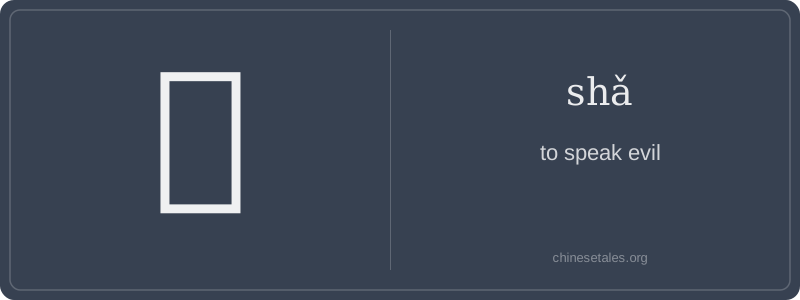
The earliest form of 唼 appears in Warring States bamboo slips — not oracle bones, but still ancient — where it combines 口 (mouth) on the left and 乏 (fá, ‘lacking, exhausted’) on the right. Wait — ‘lacking’? Yes! But look closer: 乏 itself evolved from a pictograph of a person stumbling backward, arms splayed — symbolizing depletion, failure, or moral bankruptcy. So the original idea was ‘a mouth that speaks from exhaustion of virtue’: speech so morally drained it becomes dangerous. Over centuries, 乏 simplified into its modern shape (⿱之丿), and the whole character stabilized at 11 strokes, with the 口 firmly anchoring its oral nature.
This meaning held firm through dynasties. In the *Book of Rites* (Lǐjì), it appears in warnings against ‘shǎ yán’ (evil speech) that ‘breaks trust like shattered jade’. By the Ming dynasty, novelists used it to describe villains whispering lies in courtyards — always paired with words like 毁 (ruin) or 谤 (slander). Visually, the sharp, downward stroke of 乏 (the final 丿) cuts across the mouth like a knife — a silent graphic metaphor: *words that wound*.
At first glance, 唼 (shǎ) feels like a linguistic ghost — rare, archaic, and dripping with moral weight. It doesn’t mean ‘to speak’ in the neutral sense; it means *to speak evil*: slanderous, malicious, or deeply harmful speech — the kind that poisons relationships or ruins reputations. Think of it as the Chinese counterpart to 'slander' or 'calumny' as a verb, not just a noun. Its tone is intensely negative and literary — you’ll almost never hear it in daily chat, but you’ll spot it in classical allusions, historical critiques, or formal essays condemning toxic rhetoric.
Grammatically, 唼 is a transitive verb and nearly always appears in compound verbs or set phrases — rarely alone. You won’t say *‘tā shǎ le’* (he spoke evil) without context; instead, it’s embedded: *‘shǎ yì’* (to slander unfairly) or *‘shǎ huǐ’* (to defame). Learners often mistakenly treat it like common speech verbs (e.g., 说, 讲), but 唼 carries judicial gravity — it implies intent, harm, and moral condemnation. Using it casually risks sounding melodramatic or archaically theatrical.
Culturally, 唼 reflects Confucianism’s deep suspicion of careless words: ‘A single word can ruin your virtue’ (一言丧德). It’s closely tied to the concept of *kǒu yè* (oral karma) — the idea that harmful speech creates karmic debt. A classic mistake? Confusing it with 吶 (nà, ‘to utter softly’) or 呀 (ya, sentence-final particle) because of the 口 radical — but those are neutral or grammatical, while 唼 is ethically charged. Also, its pronunciation shǎ sounds like ‘sha’ (to kill), which isn’t accidental — ancient Chinese saw evil speech as *linguistic murder*.