唷
Character Story & Explanation
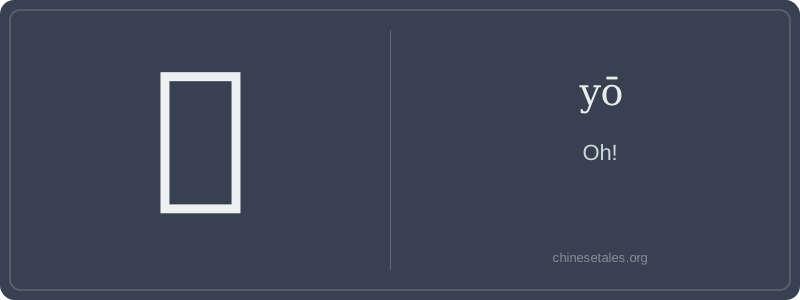
The earliest trace of 唷 isn’t in oracle bones — it’s a latecomer, born in the Ming–Qing vernacular era as a phonosemantic compound. Its left side, 口, is unmistakably the mouth — the origin of all vocal exclamations. The right side, 由, wasn’t chosen for its meaning (‘by’, ‘from’) but for its sound — yóu — which closely approximates the drawn-out, rising-fall ‘yō!’ we hear today. Stroke by stroke, it evolved from handwritten cursive variants: first the mouth radical (3 strokes), then the 由 component (5 strokes: vertical line, top horizontal, middle horizontal, bottom horizontal, vertical hook) — totaling 11 strokes, each anchoring breath and voice.
Unlike ancient pictographs, 唷 emerged from spoken language first — a transcription of real-life interjections captured by writers aiming for authenticity. In classical texts, exclamations were written with generic characters like 哉 or 乎, but by the Qing dynasty, 唷 appeared in folk stories and operatic scripts to render the bright, buoyant ‘yō!’ of street vendors, storytellers, and mothers calling kids home. Its visual simplicity — just mouth + sound — mirrors its function: zero semantic baggage, pure sonic punctuation. No wonder it thrives in dialogue: it doesn’t tell you *what* happened — it tells you *how someone felt* the moment it did.
Think of 唷 as Chinese’s theatrical gasp — not a word you’d write in an essay, but the sound that bursts out when your teacup slips, your bus pulls away, or your grandmother suddenly appears with homemade baozi. It’s a pure interjection: uninflected, unstressed, and entirely emotional. Visually, it’s built on 口 (mouth radical), signaling speech or sound, while the right side, 由 (yóu), is a phonetic hint — not for meaning, but for pronunciation (yō, close to yóu’s tone). Unlike English ‘Oh!’, 唷 carries warmth, mild surprise, or gentle exclamation — never anger or alarm (for which you’d use 啊 or 哎呀).
Grammatically, it stands alone — no particles, no modifiers, no verb agreement. You’ll hear it at the start of sentences, often followed by a pause or a smile: ‘唷!你来啦?’ (Yō! Nǐ lái la?) — ‘Oh! You’re here?’ It’s rarely written, mostly spoken or used in dialogue-heavy writing (novels, comics, subtitles). Learners sometimes overuse it trying to sound ‘natural’, but native speakers deploy it sparingly — like sprinkling chili flakes: one pinch adds zest; too much overwhelms.
Culturally, 唷 has a charmingly old-fashioned, almost Beijing opera–flavored charm. It appears in early 20th-century vernacular fiction (like Lao She’s works) and survives today in northern dialects and affectionate family talk — especially among elders addressing children. Don’t confuse it with formal writing; it’s a linguistic wink, not a grammar rule. And yes — it *can* be romanized as ‘yo’ in casual pinyin (e.g., in lyrics or texting), but that’s just phonetic shorthand, not a second pronunciation: the standard, only reading is yō.