唶
Character Story & Explanation
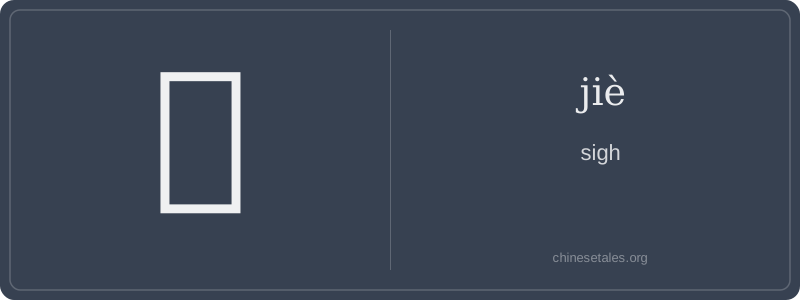
The earliest form of 唶 appears in Han dynasty bamboo slips and later seal script, not oracle bones — and its origin is refreshingly literal: it’s a phono-semantic compound where the left radical 口 (kǒu, 'mouth') signals speech-related action, and the right component 藉 (jiè, meaning 'to lie upon, to use as cushion') provides both sound and layered meaning. In ancient usage, 藉 evoked something soft, yielding, and intimate — like breath settling gently onto silence. Over centuries, the complex 藉 simplified visually into the modern 藉-like shape you see today, while retaining its phonetic anchor and emotional texture.
By the Tang and Song dynasties, 唶 had crystallized as a literary sigh — appearing in poems by Bai Juyi and essays by Ouyang Xiu to convey restrained melancholy. Unlike loud laments (嚎, háo) or sharp cries (嗟, jiē), 唶 is breath-led, mouth-initiated but voice-muted: the mouth opens just enough to release air, not sound. Its visual structure mirrors this — the 口 is compact, the right side slightly cradling it, like lips parting softly. This isn’t a cry for help; it’s the sound of the soul folding inward.
Imagine hearing a soft, involuntary exhale — not quite a word, not quite silence, but the body’s quiet punctuation of emotion. That’s 唶 (jiè): a literary, almost onomatopoeic character for sighing, especially one tinged with sorrow, weariness, or gentle resignation. It’s not casual speech; you won’t hear it in daily chats or WeChat messages. It lives in classical poetry, historical novels, and stylized modern prose — think of a scholar closing a worn scroll, or a widow gazing at rain on a courtyard wall. Its feel is hushed, introspective, and deeply human.
Grammatically, 唶 functions as an interjection or verb — but never alone. You’ll almost always see it doubled (唶唶) for rhythmic emphasis, or embedded in phrases like 唶叹 (jiè tàn) — 'to sigh and lament'. It rarely takes objects; instead, it leans on context: 唶! (jiè!) stands alone as an expressive gasp, while 唶然长叹 (jiè rán cháng tàn) paints a full portrait: 'sighed deeply, with a sense of inevitability'. Learners often misplace it as a synonym for 啊 or 哎 — but those express surprise or attention; 唶 expresses inner resonance, not outward reaction.
Culturally, this character carries the weight of literati sensibility — a tiny sonic brushstroke in China’s vast landscape of emotional vocabulary. Its rarity today makes it a subtle marker of textual sophistication. A common mistake? Assuming it’s interchangeable with 叹 (tàn), which *is* common and neutral — but 唶 adds poetic gravity, like swapping 'said' for 'murmured wistfully' in English. It’s not about volume — it’s about vibration.