唵
Character Story & Explanation
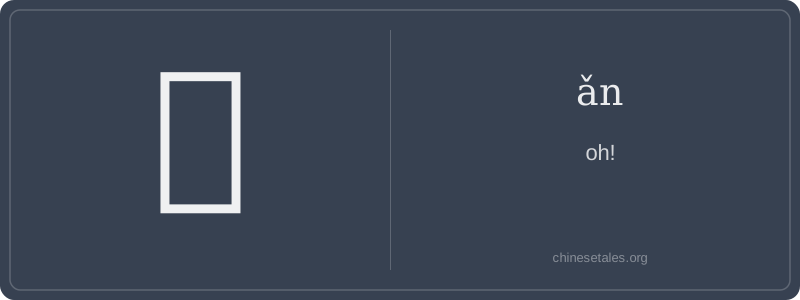
The earliest form of 唵 doesn’t appear in oracle bone or bronze inscriptions — it didn’t exist before the 7th century CE. It was deliberately invented during the Tang dynasty as a Chinese-character transcription of Sanskrit 'oṃ'. Scribes combined 口 (kǒu, 'mouth') to signal pronunciation, then borrowed 天 (tiān, 'heaven') and 毛 (máo, 'feather/hair') — not for meaning, but for their phonetic values in Middle Chinese. In Tang-era reading, 天 contributed /tʰen/ and 毛 /mɑu/, which together approximated the nasalized, humming 'om' when fused under Buddhist chant cadence. The strokes coalesced into today’s 11-stroke form through calligraphic streamlining — the top radical became compact, the lower components fused subtly at the baseline.
This character is pure phonetic engineering — a linguistic time capsule from China’s golden age of Buddhist translation. Unlike most characters that evolved organically from pictographs or ideograms, 唵 was designed like a custom font glyph: visually distinct, sonically precise, spiritually loaded. Classical texts like the *Great Prajñāpāramitā Sutra* (c. 660 CE) used it consistently in mantras — e.g., 唵嘛呢叭咪吽 — where each syllable maps to a Sanskrit root. Its visual complexity (11 strokes!) ironically serves silence: the intricate shape slows the eye and breath, anchoring the chanter before the sacred sound unfolds.
Think of 唵 (ǎn) as Chinese yoga’s 'OM' — not a word you’ll hear in daily chatter like 'hello' or 'thank you', but a sacred, resonant exclamation that vibrates in temples, meditation halls, and Tibetan Buddhist mantras. It doesn’t mean 'oh!' in the casual, surprised sense (like 'Oh! My keys!' — for that, use 哎 or 啊). Instead, it’s an archaic, ritualized interjection — a vocalization meant to center breath and intention, closer to the Sanskrit 'oṃ' than to English 'oh'. Its emotional weight is solemn, contemplative, even transcendent.
Grammatically, 唵 functions exclusively as an utterance — never as a verb, noun, or modifier. You won’t say 'I 唵' or 'the 唵 sound'; you *emit* it: 唵!— like striking a singing bowl. It appears almost always at the start of a phrase, standalone and punctuated with an exclamation mark or ellipsis. Learners sometimes misplace it mid-sentence or try to conjugate it — a dead end, since it has no inflections, no derivatives, and zero HSK presence. It’s a linguistic fossil preserved only in liturgical contexts.
Culturally, 唵 is a phonetic loan character: its shape (口 + 天 + 毛) bears no semantic relation to its sound or meaning — it was chosen purely for how 'ǎn' approximated the Sanskrit syllable oṃ in Tang dynasty transliterations. That’s why it looks so oddly ornate for such a short sound. Mistake it for a 'real' native Chinese word, and you’ll miss its true role: a sonic bridge between Indian mantra and East Asian practice — a whispered echo of enlightenment, not a vocabulary item.