唳
Character Story & Explanation
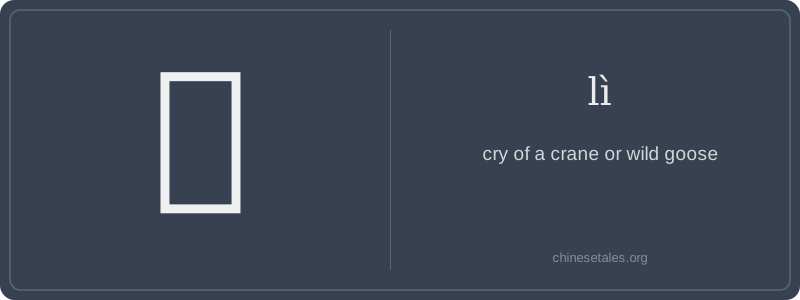
The earliest form of 唳 appears in bronze inscriptions as a combination of 口 (kǒu, mouth — indicating sound) and 丽 (lì, originally a pictograph of two antlers or paired deer, later simplified to mean ‘beautiful’ or ‘elegant’). In oracle bone script, 丽 depicted symmetry and grace — think of two long-necked cranes facing each other. Over centuries, the top part evolved into the modern 丽 (two vertical strokes + ‘鹿’-like structure), while 口 remained firmly anchored at the bottom, grounding the sound in vocalization. By the Han dynasty, the character stabilized into today’s 11-stroke form: 口 (3 strokes) + 丽 (8 strokes), visually echoing the crane’s upright posture and resonant call.
This elegant pairing wasn’t arbitrary: ancient Chinese associated cranes with immortality, wisdom, and celestial communication — their cries weren’t noise, but messages from heaven. The character 唳 thus fused *sound* (口) and *refined, auspicious presence* (丽) into one ideogram. It appears in the 4th-century text *Shì Shuō Xīn Yǔ* (A New Account of the Tales of the World), describing a recluse who ‘heard crane cries and sighed deeply’ — linking 唳 to introspection and Daoist detachment. Even today, when poets write 唳, they aren’t just noting a birdcall; they’re invoking stillness, distance, and the fragile beauty of transience.
At its heart, 唳 (lì) isn’t just ‘a cry’ — it’s the piercing, high-pitched, almost metallic *keee-eeer* of a crane or wild goose in flight. Think less ‘quack’ and more ‘shriek with elegance’. This isn’t a generic verb like 叫 (jiào); it’s highly poetic, literary, and narrowly specialized: only cranes, geese, and occasionally swans — never dogs, birds, or people. Its tone is solemn, often evoking loneliness, transcendence, or sudden alarm.
Grammatically, 唳 functions as an intransitive verb (it doesn’t take an object) and appears most often in descriptive phrases or classical-style clauses — rarely in casual speech or modern imperative sentences. You’ll see it in patterns like ‘鹤唳’ (hè lì, crane cry), ‘风声鹤唳’ (fēng shēng hè lì, wind sounds + crane cries — a famous idiom meaning ‘jumping at shadows’), or as a standalone verb: ‘长空忽闻鹤唳’ (cháng kōng hū wén hè lì — ‘Suddenly, a crane’s cry pierced the vast sky’). Learners sometimes wrongly use it for any bird sound — but no: sparrows chirp (叽叽喳喳), crows caw (呱呱), and eagles screech (唳 is off-limits).
Culturally, 唳 carries deep resonance from the Jin Dynasty’s Battle of Fei River (383 CE), where retreating Qin troops mistook wind rustling reeds and crane cries for enemy forces — birthing the idiom 风声鹤唳 (fēng shēng hè lì), now shorthand for paranoid overreaction. Because it’s so rare and literary, learners often mispronounce it as ‘lí’ (like 离) or confuse it with similar-looking characters — a sign you’re diving into classical Chinese poetry territory, not ordering dumplings.