唲
Character Story & Explanation
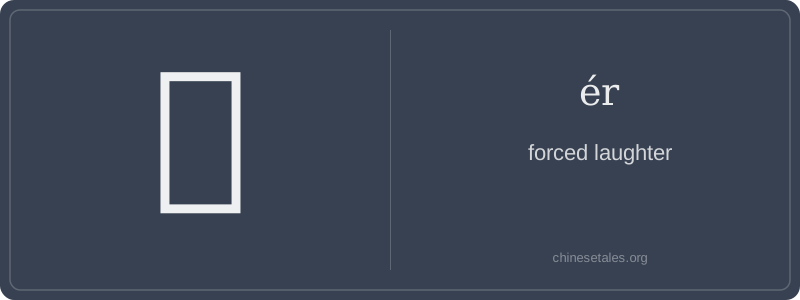
The character 唲 has no oracle bone or bronze script form — because it didn’t exist before the late imperial era. It’s a relatively young character, born from phonetic-semantic compounding during the Ming–Qing transition. Its left side 口 (kǒu, ‘mouth’) signals it’s speech- or sound-related; its right side 兒 (ér, ‘child’) provides the pronunciation — but not the meaning. Visually, it’s a deliberate fusion: the mouth radical anchoring expression, the ‘child’ component lending its sound while subtly evoking innocence *contrasted* with insincerity — as if mimicking a child’s unguarded laugh, but twisted into something performative and hollow.
This duality shaped its meaning: by the Qing dynasty, 唲 appeared in vernacular fiction like *The Scholars* (Rulin Waishi) to depict ironic or socially coerced reactions — a servant’s nervous chuckle before correcting his master, or a scholar’s brittle smile upon hearing absurd official decrees. The ‘child’ component wasn’t about age, but about *imitation*: laughing like a child might — without genuine feeling. Over centuries, this evolved into its modern sense: laughter stripped of joy, full of subtext. It’s not just sound; it’s silence wearing a smile.
Let’s be honest: 唲 (ér) is a linguistic unicorn — rare, expressive, and deeply human. It doesn’t mean ‘laugh’ in the joyful sense; it means *forced* laughter — that awkward, tight-lipped chuckle you emit when your boss tells a terrible joke, or when someone mispronounces your name for the tenth time. It carries subtle layers of discomfort, politeness, irony, or even quiet mockery. Native speakers don’t use it in casual speech; it’s literary, often found in novels, essays, or sharp social commentary — think of it as the written equivalent of an eyebrow twitch + half-smile.
Grammatically, 唲 functions almost exclusively as an interjection or a verb complement, usually following verbs like ‘say’, ‘smile’, or ‘laugh’. You’ll see it after quotation marks or as part of descriptive phrases: ‘他苦笑 ér’ (he gave a bitter laugh), ‘她干笑 ér’ (she gave a dry, strained laugh). Crucially, it’s never used alone like ‘ha!’ — it needs context to land. Learners sometimes mistakenly treat it like 哈 (hā) or 呵 (hē), but those are neutral or light; 唲 always implies tension beneath the surface.
Culturally, 唲 reveals how precisely Chinese captures emotional micro-expressions — no English word has its exact flavor. Westerners often overuse it trying to sound literary, but native writers deploy it sparingly, like a spice. A common mistake? Confusing it with 儿 (ér, ‘child’) due to identical pronunciation — but they share zero semantic ground. This character isn’t about youth; it’s about the quiet ache of social performance.