唰
Character Story & Explanation
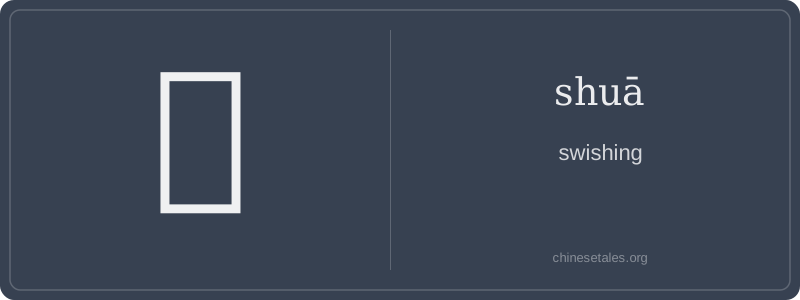
The earliest form of 唰 doesn’t appear in oracle bones — it’s a latecomer, born in the Qing dynasty as a phonosemantic compound. Its left side 口 (mouth/radical for speech and sound) signals it’s about vocalization or auditory experience. The right side 刷 (shuā, ‘to brush’) provides both pronunciation and core imagery: the original 刷 itself evolved from a bronze inscription showing a hand holding a brush-like tool over a surface. When combined into 唰, the 口 radical ‘sounds out’ the sharp, breathy release of the ‘sh’ and ‘a’ — turning the physical act of brushing into its audible signature.
This character didn’t exist before the 18th century; it emerged alongside vernacular fiction and performance arts where sound effects mattered — think Peking opera stage directions or storytellers mimicking action. In classical texts, scribes used broader terms like 拂 (fú, ‘to brush lightly’) or 扫 (sǎo, ‘to sweep’) — but never this precise, clipped ‘shwaaap!’. Its visual design is genius: the 口 radical anchors it as ‘uttered sound’, while the 刷 component — simplified to 爻+刂 in 唰 — retains the sense of rapid, repeated motion. So 唰 isn’t just what you hear — it’s what your mouth *makes* when you imitate speed and air moving in one clean stroke.
Imagine you’re in a Beijing hutong at dawn: a street-sweeper swings his bamboo broom — shuā! — and a cloud of dust rises in one smooth, rhythmic arc. That’s 唰: not just ‘swish’, but the *instantaneous, textured sound* of something fast, light, and slightly airy brushing past — a curtain flapping, a sword drawn, rain hitting a tin roof. It’s onomatopoeic first, meaning second: Chinese doesn’t use it as a verb by itself (you wouldn’t say ‘I shuā the floor’), but as an adverbial reduplication (唰唰) or standalone interjection to punctuate motion and sound together.
Grammatically, 唰 almost always appears reduplicated (唰唰) or doubled with another onomatopoeia (唰啦、唰啦啦) for rhythmic effect — think of it like English ‘whoosh-whoosh’ or ‘swish-swish’. You’ll hear it in spoken descriptions (tā yī shuā, dà mén guān shàng le — “Shwaaap! — the door slammed shut”), but rarely in formal writing. Learners often mistakenly treat it as a verb stem or try to conjugate it — big no-no. It’s pure sensory punctuation: uninflected, unchangeable, and gloriously untranslatable without sound.
Culturally, 唰 carries urban energy and kinetic immediacy — it’s the sound of modern life in motion: subway doors closing, pages flipping, a chef’s knife slicing scallions. Unlike classical literary onomatopoeia (e.g., 轟 for thunder), 唰 is colloquial, post-1950s, and thrives in spoken narratives, children’s books, and action comics. A common mistake? Overusing it in writing — native speakers reserve it for vivid oral storytelling, not essays. Its power lies in its brevity: one syllable, eleven strokes, and a whole sensory world.