唫
Character Story & Explanation
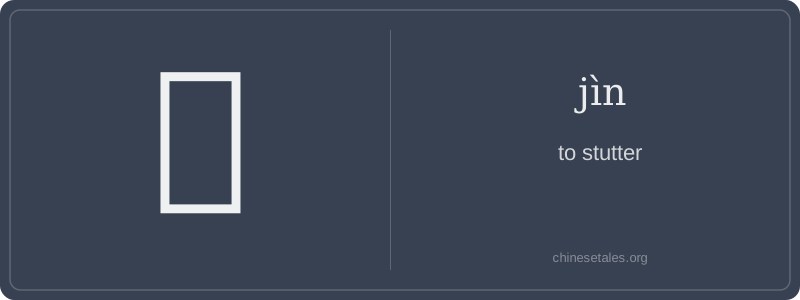
The earliest trace of 唫 appears in late Warring States bamboo texts, not oracle bones — and its form is strikingly deliberate: the 口 (kǒu, 'mouth') radical anchors the left, while the right side, now written as 金 (jīn, 'metal'), was originally a stylized depiction of clenched teeth and a constricted tongue, resembling a tightly wound coil (⺼-like) that later simplified into 金 under clerical script influence. The 11 strokes aren’t arbitrary: the three horizontal lines in 金 echo repeated, jerky mouth movements; the downward stroke of 口’s right side visually mimics a jaw snapping shut mid-sound.
This visual tension — mouth + constriction — crystallized its meaning early. In Tang dynasty poetry, 唫 appears in fragments describing poets ‘stuttering over rhymes’ (唫韵不畅), not from nervousness, but from intense phonetic labor. By the Ming, it shifted toward emotional speech impediment: a lover choking on confession, a witness trembling before authority. Unlike modern clinical terms, 唫 preserves the ancient Chinese view of speech as breath-bound and body-rooted — no mind-body split here. Its survival today is mostly poetic: a single 唫 can evoke a whole silent pause heavier than ten words.
At its core, 唫 (jìn) is a vivid, onomatopoeic verb meaning 'to stutter' — not just any hesitation, but the physical, breathy, mouth-tightening kind where sounds get stuck mid-air. It’s not abstract or polite like 说话结巴 (shuōhuà jiēba); 唫 zeroes in on the oral struggle itself: lips parting, tongue tangling, air catching in the throat. Think of it as the linguistic equivalent of a hiccup — sudden, involuntary, and deeply embodied.
Grammatically, 唫 is almost always used in reduplicated form 唫唫 (jìn jìn) or with aspect particles: 他唫唫地讲不出话来 (tā jìn jìn de jiǎng bu chū huà lái) — 'He stutters uncontrollably, unable to speak.' It rarely stands alone; you won’t say *他唫* as a full sentence. Crucially, it’s never used for 'stammering' in formal registers — no one uses 唫 in a news broadcast or legal deposition. It’s literary, colloquial, and slightly archaic, appearing most often in descriptive narration or dialect-influenced dialogue.
Culturally, learners often misread 唫 as related to 进 (jìn, 'to enter') due to identical pronunciation — a classic homophone trap. But there’s zero semantic connection: 进 is about movement across boundaries; 唫 is about vocal blockage. Also, many assume it’s interchangeable with 结巴 (jiēba), but that’s a noun/adjective ('a stammerer' / 'stammering'), while 唫 is strictly an action verb with visceral texture. Its rarity outside classical poetry and regional fiction means it’s more a 'flavor word' than a functional one — like finding a rare spice in your grandmother’s pantry.