唪
Character Story & Explanation
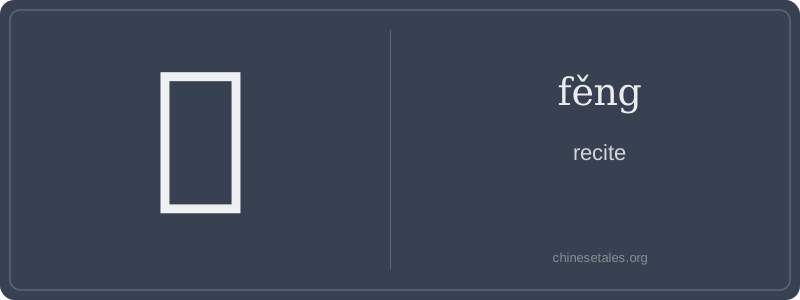
The earliest form of 唪 appears in bronze inscriptions as a combination of 口 (mouth) and 風 (fēng, wind — originally picturing air swirling around a vessel). Imagine: mouth + wind = breath-driven sound moving outward with force. Over centuries, 風 simplified: its 'insect' component (虫) vanished, and the top 'wind' banner (凡) morphed into the distinctive 凡-like shape above 口 in modern 唪 — preserving the sense of air-in-motion transformed into voiced utterance.
This visual logic shaped its meaning: not silent reading, but sound propelled by breath — hence 'recite' with resonance. In the Book of Songs (Shījīng), 唪 described chanting odes with prescribed pitch and rhythm to invoke harmony. Later, in Tang dynasty poetry criticism, it gained a sharper edge: to 'fěng' a poem was to deliver it with such tonal precision that its moral subtext became unmistakable — almost like vocal acupuncture. The character’s form — mouth launching wind — never lost that sense of intentional, directed sonic force.
Forget 'recite' as dry memorization — 唪 (fěng) carries the visceral, rhythmic energy of voice rising from the throat. Its core feeling is *oral performance with intent*: chanting scriptures, intoning poetry aloud, or even sarcastically 'reciting' someone’s flaws in a biting tone (a classical nuance still felt in literary contexts). The 口 radical isn’t just decoration; it anchors the action firmly in the physical act of speaking — lips, tongue, breath all engaged.
Grammatically, 唪 is almost always transitive and formal. You 唪 a text — never *just* 'recite' abstractly. It takes an object: 唪诗 (fěng shī, recite poetry), 唆经 (fěng jīng, chant sutras). Learners often mistakenly use it like English 'recite' without an object ('He recited well') — but Chinese requires *what* is recited. Also, it’s rarely used for casual classroom drills; that’s 背 (bèi, to recite from memory) or 朗读 (lǎngdú, to read aloud). 唪 implies reverence, ritual, or sharp rhetorical force.
Culturally, 唪 echoes ancient oral traditions where sound itself held power — think Daoist incantations or Confucian ritual odes. Modern usage is rare outside classical poetry, religious contexts, or ironic literary criticism (e.g., 'he 唪 his own failures'). Mistaking it for common verbs like 读 (dú, to read) or 念 (niàn, to read/recite) misses its weighty, performative soul — this isn’t reading; it’s vocal embodiment.