唧
Character Story & Explanation
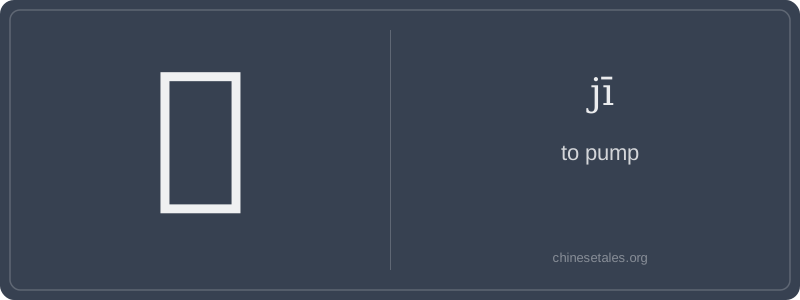
The earliest form of 唧 isn’t found in oracle bones — it’s a relatively late invention, appearing in Song-era texts and solidifying in Ming-Qing vernacular literature. Visually, it’s a brilliant fusion: the left side 口 (kǒu, 'mouth') signals sound or oral/exit action, while the right side 即 (jí, 'immediately, at once') provides both phonetic clue (jī vs. jí — same initial, tone shift) and semantic urgency. Look closely: 即 itself evolved from a pictograph of a person kneeling beside food — implying immediacy of action — and here, fused with 口, it suggests 'instant expulsion from the mouth (or nozzle)'. Every stroke serves purpose: the three dots in 即’s top become the 'spurt' — sharp, compact, unstoppable.
This character was born from spoken language, not classical writing — it’s a phonosemantic coinage designed to capture the *sound* and *force* of pumping. In the 17th-century novel Water Margin, 唧 appears in descriptions of bellows and primitive fire engines — always paired with movement: 唧进风, 唧出火. By Qing dynasty, it had expanded into metaphorical use for any sudden, repeated emission: a nervous tic (唧唧歪歪), a leaky faucet, even the rapid clicking of a typewriter. Its visual rhythm — ten strokes, tight and staccato — mirrors its meaning: no lingering, just *jī!* then *jī!* again.
At first glance, 唧 (jī) feels like a tiny, energetic burst — and that’s exactly right. It’s an onomatopoeic verb meaning 'to pump' or 'to squirt', evoking the sharp, rhythmic *jī jī* sound of air or liquid being forced out: think bicycle pumps, syringes, or even cartoonish steam vents. Unlike abstract verbs, 唧 is visceral — it’s rarely used alone but thrives in reduplicated forms (唧唧) or compound verbs like 唧出 (jī chū, 'to pump out') and 唧进 (jī jìn, 'to pump in'). Its core vibe is mechanical, physical, and slightly playful — never formal or literary.
Grammatically, 唧 almost always appears as part of a verb-complement structure or as the first syllable in vivid compound verbs. You won’t find it in isolation like 吃 or 走 — instead, it’s the 'squeak' in the action: 唧出一股水 (jī chū yī gǔ shuǐ, 'squirted out a stream of water'). Learners often mistakenly treat it as a standalone transitive verb ('I pump'), but native usage requires a directional complement (出/进/上/下) or reduplication for emphasis. Omitting this makes the sentence feel incomplete — like hearing only half a sneeze.
Culturally, 唧 carries a charmingly low-tech, tactile charm — it shows up in children’s books describing toy pumps, in old-fashioned medical texts for syringes, and even in dialectal expressions for sighing or muttering (e.g., 唧咕, jī gū, 'to grumble softly'). A common trap? Confusing it with the more common 易 (yì, 'easy') or 寂 (jì, 'silent') — their similar shapes hide wildly different meanings. Remember: 口 + 即 = mouth-action + immediacy = a quick, forceful expulsion — not silence, not ease!