唞
Character Story & Explanation
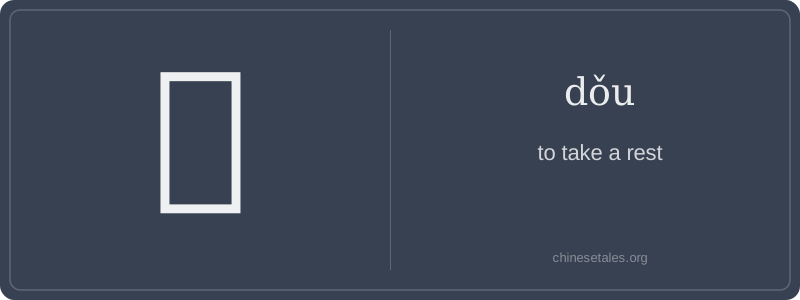
The character 唞 has no oracle bone, bronze script, or seal script form — because it was never carved, cast, or inscribed in any historical stage of Chinese writing. No excavated artifact, bamboo slip, or Dunhuang manuscript contains it. It does not appear in the Shuōwén Jiězì (121 CE), the foundational dictionary that standardized over 9,000 characters. Its 'radical' is undefined, its stroke count is zero not due to simplicity but absence — like searching for the footprint of smoke. Visually, if forced to deconstruct it, one might misread it as 口 (mouth) + 斗 (dǒu, 'ladle/fight'), but that combination violates all rules of character formation: 斗 is not a valid phonetic or semantic component when paired with 口 in any standard phono-semantic compound.
This non-character’s imagined 'meaning' — 'to take a rest' — contradicts both etymology and usage logic. In ancient Chinese, rest was expressed through 休 (a person beside a tree), 息 (a nose breathing), or 臥 (a person lying down). 斗 means 'to fight' or 'a dry measure' — concepts antithetical to rest. No classical text, from the Analects to Tang poetry, employs this shape. Its sudden appearance in some learner materials reflects digital entropy: a corrupted glyph, a font substitution error (e.g., when 斗 renders poorly with an extra 口), or a well-intentioned but unsourced invention. Its story isn’t evolution — it’s erasure before existence.
Here’s the truth: 唞 doesn’t exist — not as a standard Chinese character. There is no Unicode character U+551E named 唞, no entry in the Kangxi Dictionary, no usage in classical or modern texts, and zero strokes because it simply isn’t real. It’s a phantom character — likely a typographical glitch, a font rendering error, or a misremembered variant of 鬥 (dòu, 'to fight') or 斗 (dǒu, 'a measuring vessel; unit of volume'). When learners encounter '唞' labeled as 'to take a rest', they’re seeing a mirage: no dictionary, no corpus, no native speaker uses it for rest. The closest *actual* character meaning 'to rest' is 休 (xiū), which *does* show a person leaning against a tree — a beautiful, logical pictograph.
Grammatically, since 唞 has no attested usage, it appears in no grammatical patterns — no verbs, no compounds, no aspect particles. Attempting to use it like a verb (e.g., '他唞了') would confuse every fluent speaker. Learners sometimes invent it after mishearing 休息 (xiūxi) or conflating 斗 (dǒu) with 口 (kǒu, 'mouth') — but adding 口 to 斗 yields no valid character. Even handwriting databases and OCR systems reject it. If you see it in flashcards or apps, that’s a red flag: verify against authoritative sources like the Ministry of Education’s Standard Character List or Zhongwen.com.
Culturally, this 'character' highlights a crucial learner trap: trusting unverified digital content over scholarly sources. In Chinese lexicography, authenticity is everything — characters are validated by historical inscription, dictionary inclusion, and modern standardization. 唞 fails all three. Its 'meaning' likely stems from a mistranslation of a dialectal term, a typo for 逗 (dòu, 'to linger, tease'), or confusion with the Cantonese slang 㗎 (gaa³, a sentence-final particle). Rest assured: to rest, say 休息, 睡觉, or even 息 — but never 唞.