吣
Character Story & Explanation
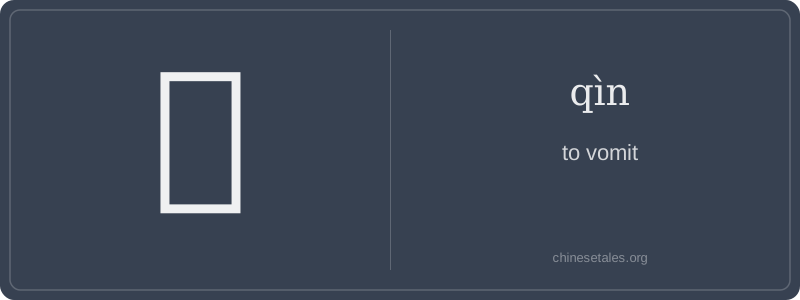
The earliest form of 吣 appears in bronze inscriptions as a mouth radical (口) with three short, jagged strokes inside — not random lines, but stylized arcs representing violent upward motion: the explosive trajectory of stomach contents bursting from the mouth. Over time, those three chaotic strokes simplified and aligned into the clean, descending diagonal (ノ), horizontal (一), and dot (丶) seen today — still visually echoing that abrupt, outward surge. The mouth radical never changed: it anchors the meaning firmly in oral expulsion.
This character first appeared in Warring States medical manuscripts describing 'qi reversal' (气逆), where 吣 denoted pathological upward movement of stomach qi. By the Han dynasty, it entered poetry — Qu Yuan’s 'Li Sao' uses 吣 metaphorically for expelling falsehoods ('vomit slander'). Its visual simplicity (just 7 strokes!) belies its loaded history: unlike 吐, which evolved from everyday speech, 吣 was preserved by literati precisely because its shape *felt* like the act — compact, urgent, and unignorable.
Imagine your friend Li Wei, pale and clutching his stomach after eating street-side stinky tofu — suddenly he doubles over and qìn! That sharp, involuntary expulsion isn’t just ‘vomiting’ in a clinical sense; 吣 captures the visceral, almost onomatopoeic *act* of heaving — abrupt, physical, and slightly archaic. It’s not the neutral 呕 (ǒu) or modern 吐 (tǔ), but a literary, sometimes dramatic verb that implies suddenness and force, often used in classical poetry or medical texts.
Grammatically, 吣 is a transitive verb: it takes a direct object (what’s expelled) and commonly appears in compound verbs like 吣出 (qìn chū, 'to vomit out') or in passive constructions with 被 (bèi). You won’t hear it in casual chat ('I vomited this morning' → 我吐了 wǒ tǔ le), but you *will* see it in phrases like 'blood was vomited' (鲜血被吣出 xiān xuè bèi qìn chū) — where the formality and gravity matter. Learners mistakenly use it like 吐, but 吣 carries weight: it’s rarely used without context implying severity, illness, or poetic intensity.
Culturally, 吣 evokes classical restraint — it’s the word Confucius might’ve used to describe a sage purging moral corruption, not lunch gone wrong. Mistake it for 吐, and you risk sounding like a Tang-dynasty physician lecturing a patient. Also beware tone: qìn (4th) ≠ qīn (1st, 'to kiss') — mispronouncing it could turn a medical report into romance fiction!