唔
Character Story & Explanation
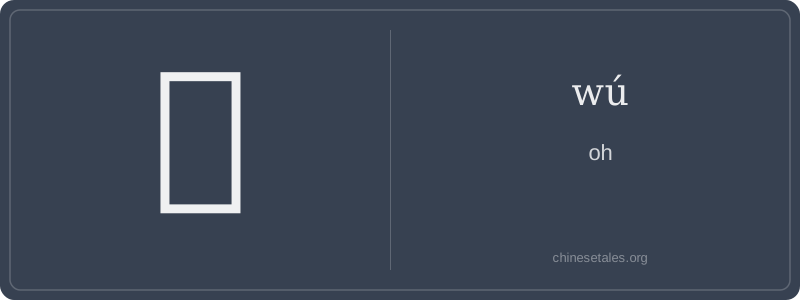
The earliest trace isn’t oracle bone — it’s a late invention, born from linguistic necessity. Around the Ming–Qing transition, scribes needed a way to write the common Southern Chinese interjection /ŋ̩/ or /m̩/, a syllabic nasal grunt (like the ‘mm’ in English ‘hmm’). They combined 口 (mouth radical) with 五 (wǔ, ‘five’) not for meaning, but because its pronunciation ‘wu’ was the closest standard character sound to approximate that guttural, voiceless nasal exhalation — then simplified the top stroke of 五 to match colloquial handwriting. The result? Ten strokes: three for 口, seven for the modified 五.
This wasn’t classical usage — you won’t find 唔 in the Analects or Tang poetry. It emerged organically in vernacular fiction and opera scripts (e.g., Cantonese ‘mou’-dialect stage directions) as writers struggled to transcribe real speech. Its visual shape — mouth plus a number — is ironic: it represents sound so primal it defies counting. Yet precisely because it’s *designed* for ear, not eye, it became indispensable in regional literature, where tone and breath carry half the meaning.
Forget textbooks — 唔 is pure spoken-sound magic. It’s not a ‘word’ in the dictionary sense, but a phonetic glyph: a mouth (口) + ‘wu’ (五, repurposed for sound), capturing the exact throaty, open-mouthed 'oh!' of sudden realization or mild protest — like when your tea’s too hot or you’ve just spotted your friend across a crowded street. It’s emphatically *not* formal; you’ll never see it in official documents or news headlines, but it’s everywhere in Cantonese and Southern Mandarin dialogue, chat logs, and subtitles — especially in emotive, unscripted speech.
Grammatically, 唔 is a sentence-initial interjection, almost always standing alone or followed by a pause (like ‘Oh—!’). Unlike 啊 or 哦, it carries subtle regional flavor: in Guangdong and Hong Kong, it often implies gentle resistance ('唔…我諗下先' — 'Hmm… let me think first'), while in some Sichuan contexts, it signals playful doubt. Learners mistakenly try to use it as a verb or attach particles — but no: it’s a frozen sound-image. Think of it as Chinese onomatopoeia carved into ink.
Culturally, 唔 is a quiet rebel: it’s absent from the HSK because it resists standardization — yet it’s more authentically ‘alive’ than many HSK words. Native speakers instantly recognize its vocal texture: low-pitched, nasal, slightly drawn-out. Mistake it for 吾 (wú, ‘I’) or 悟 (wù, ‘to realize’), and you’ll sound like you’re quoting Confucius instead of reacting to spilled coffee.