唑
Character Story & Explanation
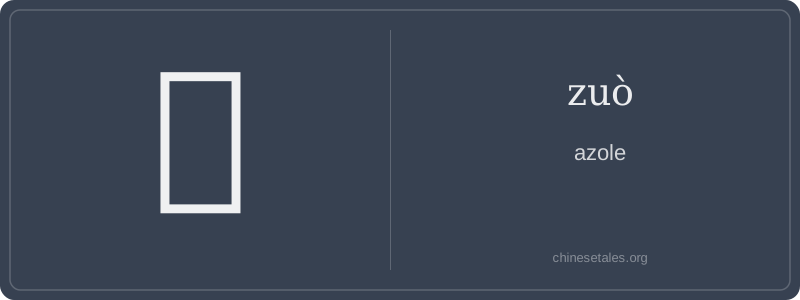
唑 has no oracle bone or bronze script ancestry — it’s a 20th-century invention. Its form is deliberately constructed: left side 口 (kǒu, 'mouth'), a standard radical for phonetic-syllable characters (like 名 míng, 吧 bā), and right side 作 (zuò), repurposed *not* for its meaning ('to do'), but purely for its sound. The 10 strokes break down cleanly: 口 (3 strokes) + 作 (7 strokes). Visually, it’s a compact, balanced character — the square mouth frames the energetic diagonal stroke of 作’s 'person' component (亻), giving it a slight 'lab-coat crispness'.
The meaning didn’t evolve — it was assigned. Unlike characters whose meanings drifted over millennia (e.g., 闻 wén, from 'to smell' to 'to hear'), 唑 entered Chinese vocabulary fully formed around the 1950s–60s, when China standardized chemical nomenclature. Classical texts never mention it; you won’t find 唑 in the Shuōwén Jiězì or Tang poetry. Its entire existence is functional, not philosophical — a linguistic docking port for Western science. Its visual simplicity (just two familiar components) masks its highly specialized role: this character is less a word than a *chemical syllable anchor*.
Imagine you're in a Shanghai pharmaceutical lab, peering through a microscope at molecular diagrams — and there it is: 唑, glowing faintly on a whiteboard next to 'imidazole' and 'triazole'. This character isn’t ancient poetry or daily conversation; it’s a precision tool — a *scientific loan character* created in the 20th century to represent the organic chemistry term 'azole', a class of five-membered heterocyclic compounds containing at least one nitrogen atom. In Chinese, 唑 carries zero native semantic weight — no emotional tone, no classical resonance — it exists purely as a phonetic placeholder: zuò approximates the 'zo' in 'azole', while 口 (mouth radical) signals it’s a *pronounced syllable*, not a pictograph.
Grammatically, 唑 never stands alone. It only appears in compound terms like 吡唑 (bǐ zuò, pyrazole) or 咪唑 (mī zuò, imidazole), always as the second character — never at sentence beginnings, never with particles like 了 or 的. Learners sometimes mistakenly treat it like a verb ('to azole!') or try to use it in isolation ('This drug contains 唑'), but that’s ungrammatical — just as English doesn’t say 'contains -zole' without the prefix. You’ll see it exclusively in technical literature, drug monographs, or chemistry textbooks — never in WeChat chats or menus.
Culturally, 唑 is a quiet testament to how Chinese absorbs modern science: not by borrowing foreign words wholesale, but by forging new characters with existing radicals and sounds. Its radical 口 isn’t about speech here — it’s a linguistic 'labeling device', marking syllables coined for transliteration. A common mistake? Confusing it with 作 (zuò, 'to do') — same pinyin, wildly different meaning and usage. Remember: if it’s in a lab report, it’s 唑; if it’s on a resume, it’s 作.