唏
Character Story & Explanation
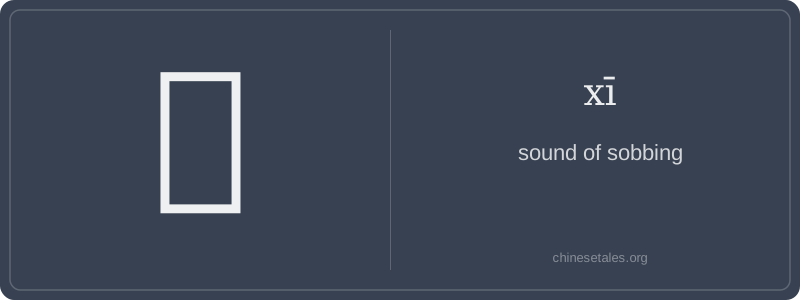
The earliest form of 唏 isn’t found in oracle bones, but its structure reveals ancient logic: the left side is 口 (kǒu, 'mouth'), the universal radical for speech and sound; the right side is 奚 (xī), a phonetic component that originally depicted a bound servant (a person 扌 + 隹, suggesting captivity). Over centuries, 奚 simplified from a complex pictograph into today’s streamlined shape — but crucially, its pronunciation remained xī, anchoring the sound value. So 唏 was born not as a picture of weeping, but as a *phonosemantic compound*: mouth + 'xī' sound = the audible sigh of sorrow.
This meaning crystallized during the Tang and Song dynasties, appearing in poetic miscellanies and vernacular storytelling where subtle emotional cues mattered. In classical texts like the *Taiping Guangji*, 唏 appears in dialogues to signal suppressed grief — not loud lamentation, but the quiet, involuntary catch in the throat before tears fall. Its visual simplicity (just 10 strokes) belies its emotional precision: every stroke serves either sound (奚) or sense (口), making it a masterclass in economical Chinese character design — where feeling is encoded not in flourish, but in phonetic fidelity and radical clarity.
晞 is a vivid onomatopoeic character — it doesn’t describe sobbing, it *sounds* like sobbing. That soft, breathy, hiccuping 'xī...' you hear when someone tries to hold back tears? That’s 唏. It’s not a verb (you don’t ‘do’ 唏), nor an adjective — it’s a *sound word*, used almost exclusively as an interjection or in reduplicated form (唏唏) to evoke fragile, restrained grief — think of a young woman wiping her eyes after a breakup, not wailing, but quietly, shakily exhaling: 'Xī... xī...'.
Grammatically, 唏 appears at the start of sentences or mid-clause, often followed by a comma or dash, and almost always paired with descriptive verbs or emotional context: 唏,她转过身去 (Xī, tā zhuǎn guò shēn qù — 'Xī... she turned away'). Learners sometimes wrongly treat it as a verb ('she xī-ed') or confuse it with sighing characters like 叹 (tàn); but 唏 is never transitive, never conjugated — it’s pure sonic texture. You’ll rarely see it in formal writing; it thrives in novels, film subtitles, and expressive spoken dialogue.
Culturally, 唏 carries quiet dignity — unlike 啊 or 哎, which can be casual or even theatrical, 唏 suggests vulnerability held in check. A common mistake is overusing it like English ‘oh...’ — but in Chinese, this sound implies specific emotional weight: sorrow with restraint, nostalgia tinged with loss. Also, watch your tone: xī (first tone) is essential — xí or xǐ would mean completely different things (‘to wash’ or ‘to joyfully receive’), making mispronunciation a semantic landmine.