唎
Character Story & Explanation
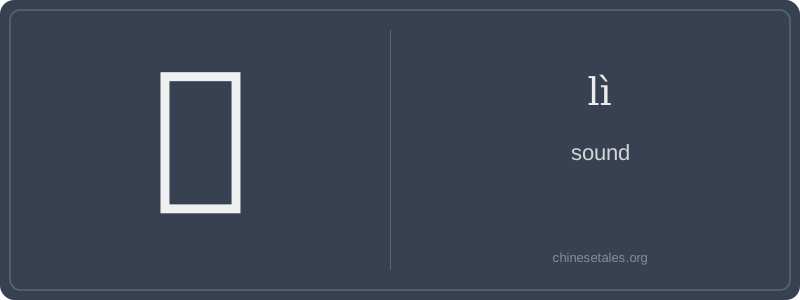
The earliest form of 唎 isn’t found in oracle bones — it’s a relatively late invention, emerging around the Ming–Qing transition as onomatopoeic writing matured. Its structure is deliberately transparent: left side 口 (kǒu, 'mouth') signals speech/sound origin; right side 利 (lì, 'sharp, advantageous') provides both sound (*lì*) and semantic reinforcement — sharp sounds are *keen*, *piercing*, *incisive*. The ten strokes evolved cleanly: 口 (3 strokes) + 刂 (2 strokes, the 'knife' radical variant of 利’s right half) + the remaining strokes of 利 (5 more), merging into today’s compact, angular shape — no pictograph, but a brilliant phonosemantic compound born from linguistic pragmatism.
Unlike ancient characters tied to ritual or agriculture, 唎 rose with vernacular fiction and oral performance. In Qing dynasty storytellers’ scripts, it appeared in phrases like ‘咕哩咕哩’ (gū lì gū lì) to mimic bubbling or rolling — emphasizing repetition and texture. Its visual sharpness mirrors its auditory role: the knife-like 刂 hints at cutting through silence, while 口 roots it in embodied vocalization. Over time, it shed any classical gravitas and settled firmly into the domain of sonic play — a testament to how Chinese writing embraces spontaneity, not just solemnity.
At first glance, 唎 (lì) looks like it should mean something serious — after all, it’s built on the mouth radical 口 and has a crisp, percussive sound. But here’s the twist: it doesn’t stand for 'sound' in the abstract sense like 声 (shēng) or 音 (yīn). Instead, 唎 is almost exclusively used as an *onomatopoeic suffix*, mimicking sharp, staccato noises — think the metallic *clink* of a spoon, the *tick* of a clock, or the *zip* of a zipper. It’s not a standalone noun; you’ll never say 'this is a lì' — it only appears fused to other syllables in reduplicated or compound forms like 啦哩 (lā lì) or 咯哩 (gē lì), where it adds rhythmic texture and colloquial flavor.
Grammatically, 唎 functions like a phonetic garnish — it rarely carries meaning by itself but modifies tone and register. It’s common in dialect-influenced speech, children’s rhymes, and literary depictions of mechanical or repetitive sounds (e.g., 砰哩砰哩 pēng lì pēng lì — 'bang-bang-bang'). Learners often mistakenly treat it as a free-standing word or confuse its function with particles like 了 (le) or 啦 (la). Remember: 唎 never initiates a sentence — it always *follows*, echoing and intensifying.
Culturally, 唎 reveals how Chinese prioritizes *aural rhythm* over lexical precision in expressive language. Its rarity in formal writing and near-absence from HSK reflects a fascinating truth: Mandarin reserves space for playful, sensory-rich vocabulary outside standardized curricula — the kind that lives in playground chants, cartoon sound effects, and grandmothers’ storytelling. Mistake it for a content word, and you’ll sound oddly robotic; use it right, and your speech gains a delightful, tactile snap.