唊
Character Story & Explanation
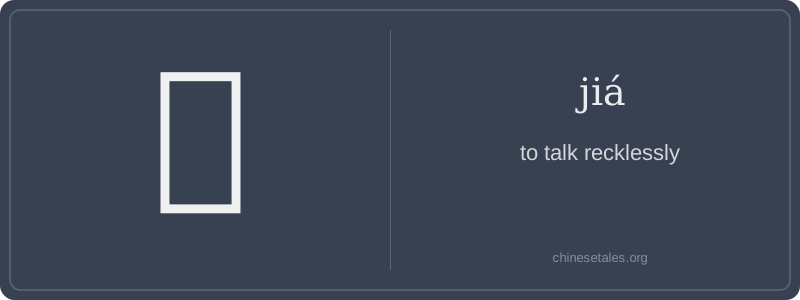
Here’s where things get delightfully weird: 唊 doesn’t appear in oracle bone or bronze inscriptions — because it’s not ancient at all. It’s a modern phonosemantic coinage, likely emerging in late Qing or early Republican era vernacular writing. Visually, it combines the mouth radical 口 (kǒu) on the left — signaling speech — with 夾 (jiā, ‘to clamp, squeeze between’) on the right. But look closer: 夾 itself evolved from a pictograph of two hands holding something tightly — imagine fingers pinching shut, then snapping open again, again, again… That kinetic tension became the visual seed for restless, uncontrolled speech.
By the 1920s–30s, writers like Lao She used 唊-like forms (sometimes written as 嘉 or even 傢 in early print variants) to capture Beijing street-slang for gabby, irresponsible talkers. Over time, the 夾 component stabilized — not for its meaning of ‘clamp’, but for its sound (jiá) and its visual suggestion of rapid, repetitive motion: lips opening/closing, tongue flapping, words spilling out without pause. There’s no classical citation (you won’t find it in the Shuōwén Jiězì), but its birth reflects how modern Chinese keeps inventing characters to nail down the *texture* of speech — not just what’s said, but *how badly* it’s said.
Let’s cut to the chase: 唊 (jiá) isn’t just ‘to talk’ — it’s to chatter *without thinking*, to blurt out nonsense, to run your mouth like a broken faucet. Think of someone interrupting a serious meeting with wild speculation or posting half-baked theories online at 2 a.m. The tone is distinctly negative and colloquial — you’d never use it in formal writing or polite conversation. It carries a faint whiff of mockery or exasperation, like saying ‘Oh, don’t just *já* about it — show me the evidence!’
Grammatically, 唊 is almost always used as a verb in the reduplicated form 唊唊 (jiá jiá), which intensifies the sense of reckless, repetitive, empty talk. You’ll rarely see it alone or in compound verbs — it doesn’t take objects easily (*not* ‘já something’), and it’s not used in the past tense with 了 unless heavily contextualized (e.g., ‘他刚才唊唊个没完’). Learners often mistakenly treat it like 說 (shuō) or 講 (jiǎng), but 唊 has no neutral register — it’s inherently judgmental and informal.
Culturally, this character lives in the margins: it appears in regional dialect-influenced fiction, satirical essays, and online banter — especially in northern Mandarin speech patterns — but you won’t find it in textbooks or official media. Its rarity explains why it’s absent from the HSK list: it’s expressive, not functional. A common learner trap? Confusing its sharp, clipped sound (jiá) with the smoother jiā or jiǎ — but remember: this word *cuts*, not glides.