唈
Character Story & Explanation
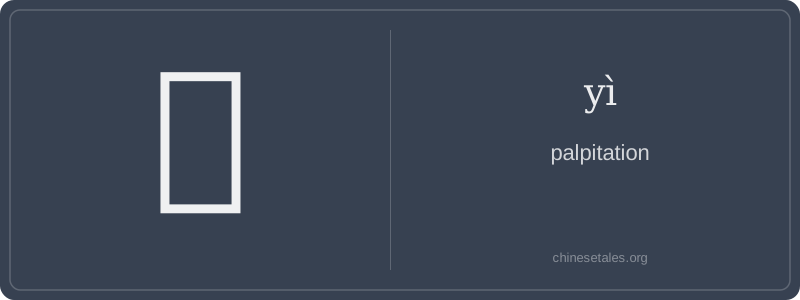
The earliest known form of 唈 appears in late Warring States bamboo texts and Han dynasty seals — not as a pictograph, but as a *semantic-phonetic compound*. Its left component 口 (kǒu, ‘mouth’) signals speech, sound, or vocal expression; its right component 忆 (yì, ‘to remember’) was borrowed *solely for its sound*, though later folk etymology linked the ‘heart-mind’ (忄/心) inside 忆 to emotional turbulence. Crucially, there is *no oracle bone or bronze inscription form*: 唈 is a relatively late invention (c. 3rd–4th century CE), born from the need to transcribe a specific, breathy vocalization in Buddhist sutra chanting and lyrical poetry — a sound too delicate for existing characters like 吁 (xū) or 嗟 (jiē).
Its meaning crystallized during the Six Dynasties period, appearing in annotated poetry collections like the *Wen Xuan* to describe the tremulous, half-suppressed exhalation of grief or awe. The character’s structure — mouth + heart — became a visual metaphor: not just ‘speaking from the heart’, but ‘the heart forcing air up through the throat’. By the Tang dynasty, 唈唈 was standard in elegies and farewell poems, always paired with physical restraint: ‘咽唈’ (yàn yì, ‘to swallow one’s 唈’) meaning to stifle sobs. Its survival today is purely literary — a fossilized whisper from China’s most emotionally restrained poetic tradition.
Think of 唈 (yì) not as a medical term, but as the Chinese language’s onomatopoeic gasp — like the sharp, involuntary catch of breath you make when startled or overwhelmed. It doesn’t mean ‘heart palpitation’ in the clinical sense (that’s 心悸 xīn jì); rather, it evokes the visceral, almost animal-like *sound* and *sensation* of a pounding chest — a fluttering, choking, breath-stopping moment. In classical and literary usage, it’s deeply poetic: less ‘my ECG shows tachycardia’ and more ‘her chest heaved with a stifled 唈 at the sight of him.’
Grammatically, 唈 is almost never used alone. It appears almost exclusively in reduplicated form 唈唈 (yì yì), functioning as an adverbial or adjectival modifier describing a trembling, agitated state — often paired with verbs like 咽 (yàn, to swallow), 哭 (kū, to cry), or 息 (xī, to breathe). You won’t find it in modern spoken Mandarin; it lives in classical poetry, early 20th-century fiction (like Lu Xun’s works), and highly stylized prose. Learners mistakenly treat it like a standalone noun — but it has no independent lexical weight outside its reduplicated, emotive context.
Culturally, 唈 carries a quiet intensity: it’s the sound before the sob, the pause before collapse. Its rarity today makes it a subtle marker of literary sophistication — like dropping ‘peradventure’ instead of ‘maybe’. A common mistake is misreading it as the much more common 易 (yì, ‘easy’) due to identical pronunciation and visual similarity in cursive script. But while 易 flows smoothly, 唈 is all constriction: mouth (口) clamped around a heart (心) — literally, a choked breath.