唅
Character Story & Explanation
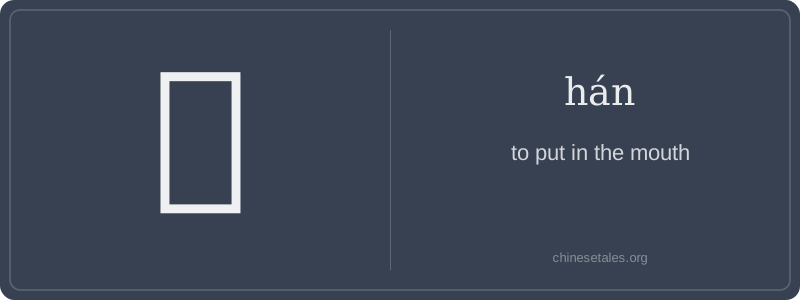
The earliest form of 唅 appears in late Warring States bamboo slips as a compound ideograph: the left side 口 (mouth) clearly drawn as a square with a dot inside, and the right side was originally a stylized hand holding a small round object — likely representing a jade bead or coin. Over centuries, that hand morphed into the phonetic component 今 (jīn), which provided sound but lost its pictorial meaning; meanwhile, the 口 radical stayed resolutely centered, anchoring the action to the mouth. By the Han dynasty clerical script, the strokes stabilized into today’s ten-stroke form: 口 (3 strokes) + 今 (7 strokes), with the top stroke of 今 curving slightly downward to echo the enclosure of the mouth.
This evolution reflects a fascinating semantic narrowing: early inscriptions used the character broadly for any mouth-related insertion (even feeding infants), but by the Tang, Confucian ritual codification elevated it specifically for mortuary rites. The Classic of Rites (《礼记》) prescribes '含玉以待终' (hold jade in the mouth awaiting death), cementing 唅 as a technical term for ritual mouth-placement. Its visual rigidity — the tight box of 口 cradling the compact 今 — mirrors its function: a precise, contained, irreversible act. Unlike fluid verbs like 吞 (swallow) or 啃 (gnaw), 唅 freezes motion at the moment of entry.
Imagine a solemn Tang dynasty funeral procession: mourners kneel beside the coffin, and an elder carefully places a small jade bead into the deceased’s mouth — not as food, but as a ritual object to preserve dignity in death. That precise, deliberate action — inserting something *into* the mouth — is the soul of 唅 (hán). It’s not eating, not speaking, not even tasting; it’s the quiet, intentional placement of an object *inside* the oral cavity, often with ceremonial or symbolic weight. This isn’t a casual verb — you won’t see it in 'I ate dumplings' (that’s 吃). Instead, it appears in classical texts, medical manuals, or historical dramas describing rites like mouth-bead placement (含玉) or administering medicine directly (含药).
Grammatically, 唅 is a transitive verb requiring a direct object and almost always appears in formal or literary contexts. It takes the structure [Subject] + 唅 + [Object], e.g., ‘他含着一枚铜钱’ (He held a copper coin in his mouth). Note the aspect particle 着 — this character rarely stands alone without a complement indicating state or purpose. Learners mistakenly substitute it for 含 (hán, same pronunciation!), which means 'to hold in the mouth' more generally (e.g.,含笑, to smile faintly), but 唅 is narrower, stricter, and rarer — it implies *insertion*, not just holding.
Culturally, 唅 carries deep funerary resonance: ancient Chinese believed placing jade, coins, or pearls in the mouth prevented spirit leakage and ensured safe passage to the afterlife. Modern usage is nearly extinct outside historical reenactments, academic writing, or poetic license — making it a linguistic fossil. The biggest pitfall? Confusing it with 含 (identical pinyin, different meaning/usage) or assuming it’s interchangeable with 放进嘴里 (put into mouth) — which is colloquial and neutral, while 唅 is ritualistic and archaic.