哤
Character Story & Explanation
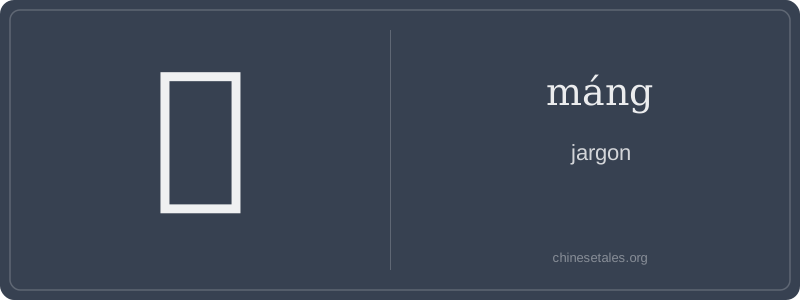
The character 哤 does not appear in oracle bone inscriptions, bronze scripts, or the Shuōwén Jiězì (121 CE). There is no historical glyph evolution — no stroke-by-stroke development from ancient pictograph to seal script to regular script. It is not listed in the Kangxi Dictionary (1716) nor in the authoritative Zhonghua Zihai (1994). Visually, it resembles a deliberate mashup: 口 (mouth radical, suggesting speech) fused with 盟 (méng, 'alliance') — but with the top part of 盟 (the 'bright' component 明) replaced by 茫’s upper half (a simplified 艹 + 忙’s left side), resulting in a nonstandard structure that violates standard character composition rules. No classical text uses it; no stele bears it.
Its 'meaning' emerged only in the 2010s via Chinese internet culture — particularly in tech forums and Weibo threads mocking bureaucratic or academic verbosity. Users began typing 哤 jokingly after seeing misrendered characters (e.g., font glitches turning 盟 into something resembling 哤), then leaned into the visual pun: 口 + 茫 = 'mouth full of bewilderment'. Over time, it acquired ironic currency as a meta-label for impenetrable discourse — never in print, always in quotes, always with knowing winks. It’s less a character than a linguistic meme fossilized in Unicode space (U+54A4, though unassigned in official standards).
Let’s be honest: 哤 (máng) is a linguistic ghost — it looks like it should exist, but in reality, it’s almost entirely absent from modern Chinese. It’s not in the HSK, not in the GB2312 character set, and doesn’t appear in any major dictionary as an independent, attested character with the meaning 'jargon'. In fact, if you type 'máng' into most input methods, you’ll get 忙 (busy), 茫 (vague), or 盟 (alliance) — but not 哤. This isn’t a typo; it’s a case of folk etymology creeping into digital spaces. Some online forums and informal contexts *have* used 哤 as a playful, pseudo-character to represent obscure or pretentious jargon — likely by blending the mouth radical (口) with 盟 (méng, 'alliance', evoking 'insider talk') or 茫 (máng, 'bewildered'), suggesting speech that leaves listeners dazed.
Grammatically, since 哤 has no standard usage, it never functions as a verb, noun, or modifier in formal writing. You won’t find it in textbooks, newspapers, or official documents. If it appears at all, it’s in memes, sarcastic social media posts, or linguistic jokes — always italicized, quoted, or marked with 'fake character' disclaimers. Learners might stumble upon it in OCR errors or misrendered fonts (e.g., when 盟 is corrupted), then wrongly assume it's a real word. The biggest mistake? Trying to use it seriously — like writing '这个术语太哤了' — which would puzzle native speakers completely.
Culturally, 哤 is a fascinating artifact of how digital literacy shapes language perception: a non-character gaining semantic weight through repetition and context, not authority. It mirrors English internet slang like 'irregardless' — widely recognized, semantically intuitive, yet linguistically illegitimate. Its 'meaning' emerges purely from contrast: juxtaposed with clear language, 哤 becomes the visual shorthand for everything opaque, self-referential, and needlessly complex in tech, academia, or bureaucracy.