哢
Character Story & Explanation
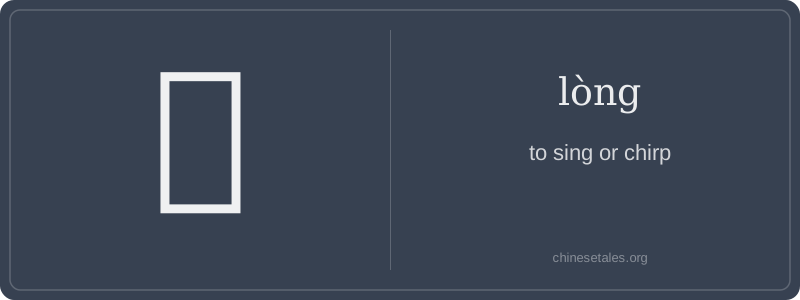
There’s a twist: 哢 doesn’t appear in oracle bone or bronze inscriptions — it’s a latecomer, first reliably attested in Song dynasty rhyme dictionaries and Ming-Qing vernacular fiction. Its form is deliberately constructed: left side 口 (kǒu, ‘mouth’) signals speech/sound; right side is 龍 (lóng, ‘dragon’), not for myth, but for phonetic borrowing — the ‘lóng’ sound anchors pronunciation. Over centuries, 龍 was simplified in this compound, losing strokes to become the modern right-hand component, visually echoing the coiled, rising energy of a vocal cry.
The meaning evolved precisely because of that dragon link: dragons in Chinese folklore don’t roar — they emit resonant, auspicious, sky-piercing sounds (like the mythical ‘dragon’s chant’). So 哢 absorbed that connotation of powerful, natural, untamed vocalization — not human artistry, but primal sonic force. Classical poets used it sparingly for birdsong (e.g., ‘lòng tí shān shàng niǎo’ — ‘chirping birds on the mountain’), while folk storytellers employed it for comical, exaggerated cries. Its visual shape — mouth + dragon — remains a perfect icon: voice unleashed with mythic volume and vitality.
Here’s the truth no textbook tells you: 哢 (lòng) isn’t just ‘to sing’ — it’s the sound of unrestrained, almost animal-like vocal joy. Think not opera or karaoke, but a bird bursting into song at dawn, a child shrieking with laughter, or a rooster crowing defiantly at sunrise. It carries vivid onomatopoeic energy — the ‘lòng’ sound itself mimics a bright, open-throated burst (like ‘long’ with a rising, bouncy tone). This isn’t polite singing; it’s spontaneous, physical, and often slightly wild.
Grammatically, 哢 is almost exclusively used in reduplicated form — lòng lòng — or as part of fixed literary or dialectal expressions like lòng tí (chirping repeatedly). You’ll rarely see it alone in modern Standard Mandarin; it’s not a verb you conjugate like ‘sing’ (唱). Instead, it appears in descriptive phrases: birds lòng lòng, cicadas lòng lòng, even a baby’s delighted yelps might be described that way in poetic or regional writing. Learners mistakenly try to use it like 唱 (chàng), but that’s like swapping ‘caw’ for ‘sing’ — same action, wildly different register and flavor.
Culturally, 哢 reveals how Chinese lexicalizes *sound quality* over abstract action. It’s not about the act of producing music, but the specific timbre — sharp, clear, rhythmic, unmodulated. That’s why it’s absent from HSK: it’s too niche, too sensory, too tied to classical imagery and regional speech. Mistake it for a general ‘sing’ verb, and your sentence won’t be wrong — just jarringly poetic or oddly rustic, like quoting Tang poetry at a business meeting.