哞
Character Story & Explanation
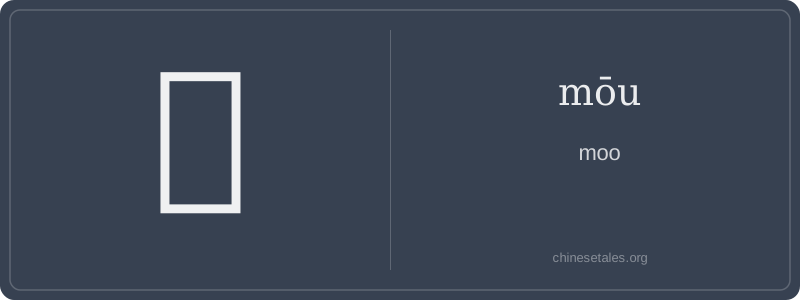
The earliest form of 哞 appears not in oracle bones, but in late Warring States bamboo slips — already recognizable as a mouth radical (口) paired with 卯 (mǎo), a phonetic component that also meant ‘sprouting’ or ‘opening’ in ancient timekeeping. The 口 radical anchors it as a vocalization, while 卯, drawn with two symmetrical strokes across a central vertical line, evokes both the rhythmic opening-and-closing of a cow’s mouth and the timing of dawn — when cattle traditionally begin lowing. Over centuries, the 卯 component simplified from a complex pictograph of interlocking branches into today’s clean, balanced structure: three horizontal strokes sandwiched between two verticals.
This visual rhythm mirrors the sound itself — deep, sustained, and evenly pulsed. In classical texts, 哞 rarely appears alone; instead, it emerges in Han dynasty agricultural records and Tang dynasty pastoral poems as part of compound sound-descriptions (e.g., ‘哞噫’ for layered animal calls). Its enduring power lies in how perfectly form echoes function: nine strokes, like nine slow breaths — one for each resonant ‘mōu’ echoing across a misty field at sunrise.
哞 (mōu) is pure onomatopoeia — it doesn’t mean ‘cow’ or ‘animal’; it *is* the sound a cow makes, rendered in ink and tone. Think of it as Chinese’s version of ‘moo’, but with linguistic gravity: it’s not a childish cartoon sound, but a fully grammatical, tonally precise syllable used in literature, children’s books, and even poetic descriptions of rural life. Its core feeling is earthy, resonant, and gently humorous — never rude or crude, but always vividly auditory.
Grammatically, 哞 functions as an interjection or verb — you can say ‘牛哞了一声’ (The cow let out a ‘mōu’) or just shout ‘哞!’ to imitate or playfully summon. Unlike English, where ‘moo’ stays frozen as a noun or verb, 哞 can take aspect particles (e.g., 哞了, 哞着) and even reduplicate for emphasis (哞哞), making it surprisingly flexible. Learners often mispronounce it as ‘móu’ (second tone) — but it’s firmly first tone: mōu, like ‘dough’ without the ‘d’, held long and low.
Culturally, 哞 appears in folk songs, nursery rhymes (like the classic ‘小毛驴’), and idiom-adjacent phrases like ‘牛气冲天’ — where the cow’s presence (and its iconic 哞) subtly reinforces strength and groundedness. A common mistake? Assuming it’s part of formal vocabulary — it’s not in HSK because it’s *too* colloquial and sensory: it lives in ears, not exams.