哐
Character Story & Explanation
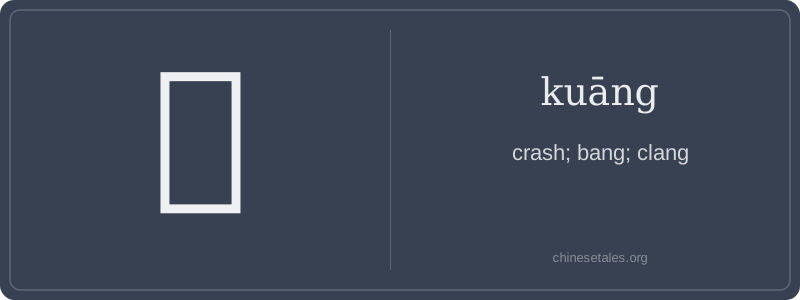
The earliest form of 哐 appears not in oracle bones (too late for that era) but in Song–Yuan dynasty vernacular manuscripts, where it emerged as a phonosemantic compound. Its left side 口 (kǒu, ‘mouth’) signals it’s a sound-related character — not because mouths make this noise, but because Chinese script classifies all vocalized or imitated sounds under 口. The right side 匡 (kuāng) was borrowed purely for its pronunciation and visual heft: 匡 itself means ‘basket’ or ‘frame’, and its angular, boxy shape — with its four-sided enclosure — mirrors the sharp, bounded quality of the sound: short, contained, reverberating within defined edges.
Over centuries, 哐 shed any literal association with baskets and became fully autonomous as a sound symbol. By the Ming dynasty, it thrived in vernacular novels like Water Margin, where editors used it to dramatize sudden violence: ‘只听哐啷一声,铁链尽断。’ (Zhǐ tīng kuānglāng yī shēng, tiě liàn jìn duàn.) Though not in classical poetry, its rise reflects a shift toward immersive, sensory storytelling — where readers didn’t just read action, they *heard* it. Visually, those nine strokes form a tight, slightly lopsided rectangle (口) hugging a rigid frame (匚 + 王), echoing how the sound hits — fast, hard, and instantly contained.
Think of 哐 (kuāng) as Chinese onomatopoeia’s equivalent of a cartoon ‘KABOOM!’ — but with the visceral, metallic sharpness of a dropped wok hitting concrete. It doesn’t just mean ‘bang’; it evokes a heavy, hollow, resonant *clang* — the sound of a temple bell struck off-center, a steel gate slamming shut, or a trash can top clattering down a stairwell. Unlike English’s generic ‘bang’, 哐 is strictly auditory and vividly physical: you *feel* its weight in your jawbone.
Grammatically, 哐 is almost always used as an interjection or reduplicative adverb (e.g., 哐当 kuāngdāng), never as a verb or noun. You won’t say ‘I 哐ed the door’ — instead, you’d write: ‘门一开,哐!—— 一只猫窜了出来。’ (Mén yī kāi, kuāng! — Yī zhī māo cuàn le chūlái.) Notice how it stands alone, punctuating action like a drum hit — no subject, no tense, just pure sonic impact. Learners often mistakenly try to conjugate it or pair it with 是 or 了, but 哐 lives outside grammar: it’s punctuation made sound.
Culturally, 哐 appears most often in vivid narrative writing — children’s books, comic dialogue, or suspenseful prose — where sound drives rhythm and mood. It’s rarely spoken aloud in formal speech (unlike 啊 or 哎), and almost never appears in academic or bureaucratic texts. A common mistake? Confusing it with 咣 (guāng), a near-identical-looking variant used more for lower-pitched, booming sounds (e.g., thunder). But 哐 is sharper, brighter, and more abrupt — like a cymbal crash versus a bass drum thud.