哋
Character Story & Explanation
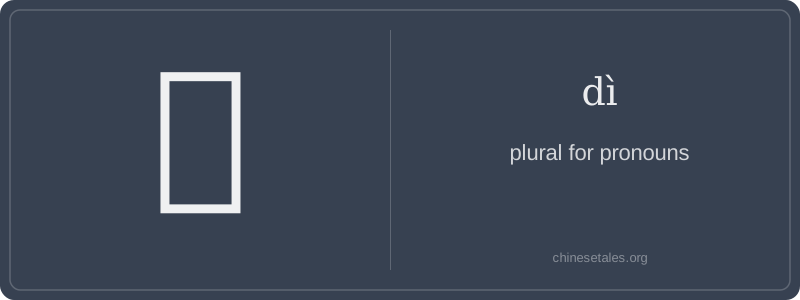
Here’s the surprise: 哋 has no ancient oracle bone or bronze script ancestry — it’s a relatively young character, born in late imperial Cantonese vernacular writing. Its form fuses the mouth radical 口 (kǒu) — signaling speech and sound — with 地 (dì, 'ground, place'), repurposed not for meaning but for phonetic resonance. Early Qing dynasty manuscripts show scribes using 地 as a phonetic loan for the local plural ending /tɐi̯/, then adding 口 to emphasize its spoken, colloquial nature. Over time, the left 口 shrank and tightened, while the right side simplified from full 地 to a streamlined, almost cursive form — resulting in today’s compact, two-component glyph.
This character didn’t evolve through classical literature — you won’t find it in the Analects or Tang poetry. Instead, it grew in Cantonese opera scripts, early 20th-century tabloids, and handwritten letters among Guangdong merchants. Its visual logic is pragmatic: 口 says 'this is said aloud'; 地 hints at the sound /dɪ/ or /tɐi̯/ — a phonetic anchor, not a semantic one. So while 地 means 'ground', 哋 means 'all of you' — a brilliant case of Chinese characters bending sound over sense, purely to capture how real people talk.
Here’s the truth no textbook tells you: 哋 (dì) isn’t a standard Mandarin character — it’s a Cantonese colloquial plural marker, used *only* after pronouns like 你 (nǐ → 你哋 nǐ dì 'you all'), 佢 (kéui → 佢哋 kéui dì 'they'), and sometimes 我 (ngóh → 我哋 ngóh dì 'we'). It carries zero formal weight in Putonghua, yet pulses with the rhythm of Hong Kong street talk, Guangzhou teahouses, and diaspora WhatsApp groups. Its feel is warm, informal, and distinctly communal — not grammatical abstraction, but lived togetherness.
Grammatically, 哋 attaches like a suffix — never stands alone, never takes tones of its own (always neutral tone), and never appears in writing outside spoken-language contexts like subtitles, lyrics, or social media. Learners mistakenly try to use it in Mandarin ('wǒ dì'?) or confuse it with Mandarin’s 们 (men). But 哋 isn’t ‘men’ — it’s Cantonese’s own rhythmic, tonal, mouth-felt solution to pluralizing people. Think of it as Cantonese adding a little verbal wink: 'you? Yeah, you — and your whole crew.'
Culturally, 哋 reveals how Southern Chinese languages prioritize phonetic efficiency and relational nuance over rigid morphology. It’s rarely taught in classrooms, so learners only encounter it through immersion — often misreading it as 'dì' (like 地) and stumbling into awkward pauses. Bonus trap: in handwritten Cantonese, 哋 is sometimes casually written as 哋 (same pronunciation), but the official Jyutping romanization remains 'dī' (though pronounced with a low falling tone, /tɐi̯˧/). It’s linguistic street slang with centuries of oral pedigree — and zero patience for textbook rules.