哃
Character Story & Explanation
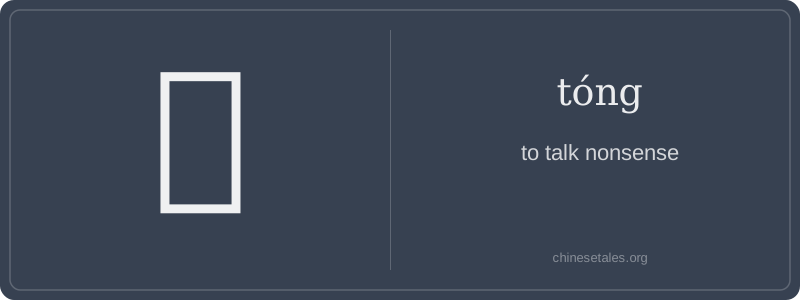
The character 哃 has no oracle bone or bronze script ancestry — it’s a latecomer, first appearing in Song-Yuan dynasty vernacular texts as a phonosemantic compound. Its left side 口 (kǒu, 'mouth') signals speech-related meaning, while its right side 同 (tóng) serves purely as a phonetic clue (both share the tóng reading). Visually, it’s strikingly simple: just 口 + 同 — yet that simplicity is deceptive. Unlike many ancient characters carved with ritual gravity, 哃 was born from scribal shorthand and oral storytelling, where scribes needed a quick, vivid way to write 'babble' in comedic dialogue — hence its light, almost playful structure.
Its meaning crystallized in Yuan dynasty zaju plays and Ming novels like The Plum in the Golden Vase, where servants or pretentious minor officials would be described as 哃言哃语 — their speech visually 'matching' 同 (sameness) to imply monotonous, repetitive, empty rhetoric. Over time, the reduplication became grammaticalized: 哃哃 (tóngtóng) evolved into an onomatopoeic adverb meaning 'incoherently, nonsensically'. The character never entered formal education or dictionaries until the 20th century — surviving instead through performance texts and folk usage, making it a linguistic fossil preserved by theater, not textbooks.
Think of 哃 (tóng) as Chinese internet slang’s answer to 'spouting hot air' — but with a distinctly poetic, almost theatrical flair. It doesn’t just mean 'to talk nonsense'; it evokes *performative absurdity*: rambling, self-important babble delivered with misplaced confidence — like a TED Talk given by a squirrel on quantum acorn theory. Unlike generic words for 'nonsense' (e.g., 胡说 húshuō), 哃 carries gentle mockery and rhythmic cadence, often used in literary or satirical contexts, not casual chat.
Grammatically, 哃 is almost always a verb, typically appearing in reduplicated form (哃哃) or as part of fixed expressions like 哃言哃语 (tóng yán tóng yǔ), meaning 'nonsensical prattle'. It rarely stands alone — you won’t hear someone say '他哃' (tā tóng) alone; it’s '他哃言哃语' or '满嘴哃话'. Learners mistakenly treat it like a synonym for 说 (shuō) or 胡说 — but using 哃 without its characteristic reduplication or compound framing sounds jarringly archaic or outright incorrect.
Culturally, 哃 lives on the edge of classical and modern: it appears in Ming-Qing vernacular fiction (e.g., satirizing pedantic scholars), then reemerged online among Gen-Z netizens reviving obscure characters for ironic effect. A common pitfall? Assuming it’s interchangeable with 同 (tóng, 'same') — they share pronunciation but zero semantic overlap. And no, it’s not related to the interjection 哦 (ò) — despite the mouth radical, 哃 is never used to express realization. It’s all about the *theatrics* of nonsense.