咿
Character Story & Explanation
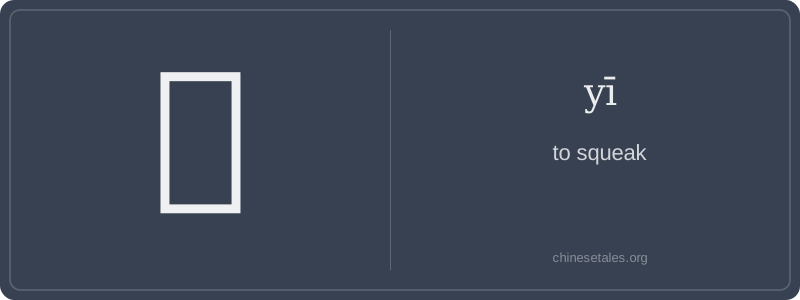
The earliest form of 咿 doesn’t appear in oracle bones — it’s a later invention, emerging around the Han dynasty as Chinese writing systematized onomatopoeia. Visually, it’s a clever fusion: left side 口 (kǒu), the universal mouth radical, anchors it as vocal; right side 伊 (yī), a pre-existing character meaning ‘that one’ (used in classical poetry like the *Shijing*), was borrowed *phonetically* — its pronunciation matched the desired squeak. Over centuries, 伊 simplified from a complex form (亻+尹) to today’s streamlined shape, and the whole character stabilized at nine strokes: three for 口, six for 伊 — no hidden radicals, no alternate forms. Its simplicity is intentional: minimal strokes for a minimal sound.
By the Tang and Song dynasties, 咿 appeared in poetic miscellanies describing infant babble (e.g., Bai Juyi’s nursery verses) and in vernacular fiction to render delicate, rhythmic sounds — always reduplicated, always gentle. The visual pairing of ‘mouth’ + ‘that one’ subtly reinforces its use: it’s the sound *of* a specific, vulnerable being — not abstract noise. Even today, seeing 咿 triggers that mental image: a tiny mouth, slightly open, releasing a fragile, questioning little yī — not a word, but a presence.
Think of 咿 (yī) as the Chinese onomatopoeic whisper of a tiny, fragile sound — not a full cry, but that first breathy, unformed squeak a newborn makes when startled, or the soft, high-pitched creak of an old wooden drawer being pulled open. It’s not loud or sharp like 啊 (ā) or 哇 (wā); it’s delicate, hesitant, almost tentative — and that’s baked right into its structure: the 口 (mouth) radical tells you it’s vocal, while the right side ‘伊’ (yī) gives both sound and a subtle sense of intimacy (‘Yī’ was an ancient poetic pronoun meaning ‘he/she/that one’). So 咿 isn’t just noise — it’s *personalized* noise, often tied to vulnerability or infancy.
Grammatically, 咿 is almost always used reduplicatively — 咿咿, 咿咿呀呀 — never alone. You’ll hear it in baby talk contexts (e.g., ‘baby babbles 咿咿呀呀’) or to evoke gentle, repetitive mechanical sounds (a rusty hinge, a rocking cradle). Crucially, it’s *not* used for human speech with content — you’d never say ‘he said 咿’ to mean ‘he said “yī”’. That’s a classic learner trap! It’s purely expressive, not lexical.
Culturally, 咿 carries a tender, slightly nostalgic tone — think of lullabies, grandparents mimicking infants, or literary descriptions of dawn birdsong or wind through reeds. Western learners often overuse it trying to ‘sound native’, but native speakers reserve it for poetic or affectionate registers. Misplacing it (e.g., using it in formal writing or as a standalone verb) instantly signals non-native fluency — it’s a character that whispers authenticity, not shouts it.