咾
Character Story & Explanation
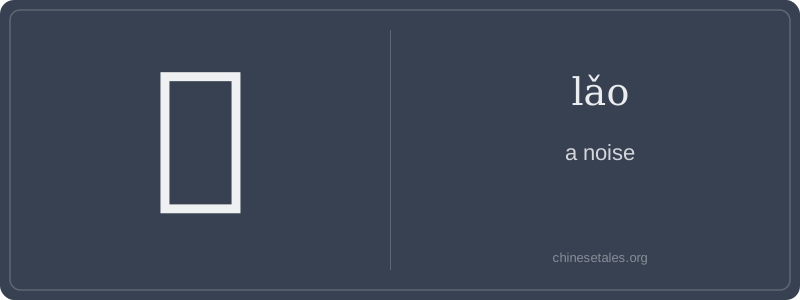
The earliest trace of 咾 appears not in oracle bone script — where it’s absent — but as a late variant form in Song dynasty lexicographic manuscripts. Its structure is transparently analytical: 口 (kǒu, ‘mouth’) on the left, and 老 (lǎo, ‘old’) on the right — but crucially, 老 here is *not* semantic. In ancient phonetic loan usage, 老 was borrowed solely for its sound (lǎo) to indicate the vocalized noise, while 口 anchors it to oral/aural production. Visually, the nine strokes evolved from simplified clerical script: the top three strokes of 老 (耂) became two horizontal lines plus a dot, and the lower ‘x’ shape (匕) condensed into a compact hook — giving the modern form its slightly top-heavy, grumbling silhouette.
This character never appeared in pre-Qin texts or the Shuōwén Jiězì. It emerged during the Northern Song (960–1127) as lexicographers needed a way to notate non-standard, low-register phonemes that didn’t fit existing characters. The choice of 老 wasn’t random: its deep, resonant tone (third tone) and open-mouthed articulation matched the intended sound quality — a guttural, sustained vibration, like wind through stone crevices. By the Ming dynasty, it was already relegated to marginalia, surviving only because scholars valued phonetic precision over usage frequency. Its visual form — mouth + ‘old’ — thus became a silent pun: not ‘old mouth’, but ‘mouth making the *lǎo* sound’.
Let’s get real: 咾 (lǎo) is a linguistic ghost — it’s in dictionaries, but you’ll almost never hear it spoken or see it written outside of specialized contexts like classical poetry annotations or dialectal phonetic glosses. It doesn’t mean ‘old’ (that’s 老, lǎo), nor does it carry emotional weight like many mouth-radical characters (e.g., 叫 jiào ‘to shout’, 喊 hǎn ‘to yell’). Instead, 咾 is purely onomatopoeic and archaic: it denotes a vague, low, rumbling noise — think the groan of a rusty hinge, the gurgle of thick liquid, or the indistinct murmur of distant crowd chatter. Its core feel is *textural*, not semantic: it’s about auditory texture, not meaning.
Grammatically, 咾 is nearly extinct as an independent word. You won’t find it in modern verbs, adjectives, or compounds used in daily speech. It appears only as a standalone interjection in rare literary or dialectal descriptions — and even then, always with tone-marked pinyin (lǎo) to signal it’s not the homophone 老. Learners often misread it as 老 due to identical pronunciation and similar stroke count (9 vs. 6), leading to hilarious mistranslations like ‘the old sound’ instead of ‘a low, guttural noise’. It’s never used predicatively (‘It is 咾’) or transitively — it simply *is* the noise, frozen in script.
Culturally, 咾 survives as a fossilized echo in philological footnotes — scholars use it when transcribing obscure regional pronunciations or reconstructing Tang dynasty rhyme tables. Its rarity makes it a trap for overconfident beginners who assume all 9-stroke 口 characters are functional. Fun fact: no major Chinese corpus (including the 100-million-word BCC) contains a single verified instance of 咾 in post-1949 published text. It’s less a living word than a paleontological specimen — beautiful, precise, and utterly dormant.