呙
Character Story & Explanation
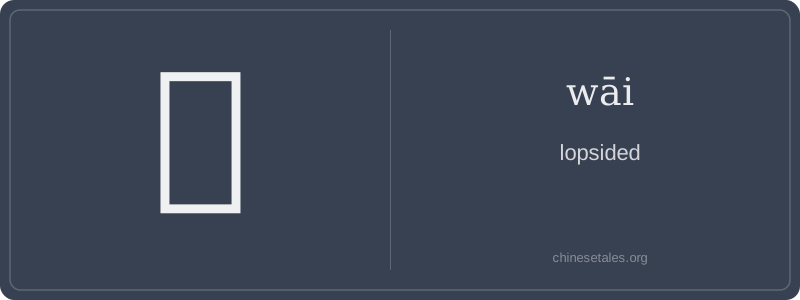
The earliest form of 呙 appears in late Warring States bamboo slips as a stylized depiction of a human head tilted sideways — the top stroke representing a slanted crown or hairline, the middle '口' suggesting the face or mouth, and the three downward strokes evoking asymmetrical shoulders or a leaning posture. Over centuries, the head-and-shoulders pictograph simplified: the upper slant hardened into a single diagonal stroke (), the face became 口, and the body condensed into two quick downward strokes — yielding today’s seven-stroke structure: + 口 + 丿 + 丿. The radical 口 here doesn’t mean 'mouth' literally; it anchors the character visually as a 'face zone', reinforcing its connection to expression and orientation.
This character’s meaning stayed remarkably stable: from 'tilted head' in early texts like the *Shuōwén Jiězì* commentary (where it’s glossed as 'not upright; leaning') to modern colloquial use for anything physically or figuratively off-axis. Unlike many characters that broadened semantically, 呙 narrowed — losing ground to 歪 in standard usage by the Tang dynasty. Yet it survives in Ming-era poetry describing '呙云' (skewed clouds) and Qing opera scripts noting '呙步' (a lopsided gait), always carrying poetic weight precisely because of its rarity and visual tension.
At first glance, 呙 (wāi) feels like a linguistic rebel — it’s not in the HSK, rarely appears in textbooks, and yet native speakers use it daily to describe that deliciously imperfect tilt: a crooked smile, a lopsided stack of books, or even a slightly off-kilter political stance. Its core vibe is visual imbalance — not broken, not wrong, but charmingly askew. Think 'wonky' in British English or 'cockeyed' in American slang: playful, descriptive, and deeply embodied.
Grammatically, 呙 functions almost exclusively as an adjective — always before a noun (e.g., 呙嘴 'crooked mouth') or after 得 in result complements (e.g., 笑得嘴都歪了 'laughed so hard their mouth went crooked'). Crucially, it’s never used predicatively without support: you *can’t* say '他的嘴很呙' — that’s ungrammatical. Instead, you’d say '他的嘴歪了' (his mouth *became* crooked) or '他歪着嘴笑' (he smiled with a crooked mouth). Learners often overgeneralize it like 'bad' or 'wrong', but 呙 is purely about physical or metaphorical slant — never moral judgment.
Culturally, 呙 carries light irony and warmth — describing someone’s '呙鼻子' (lopsided nose) isn’t insulting; it’s affectionately observational, like noting a dimple. It also appears in regional dialects and internet slang (e.g., '这事儿有点呙' — 'this situation’s kinda skewed'), where it subtly implies systemic imbalance rather than personal flaw. A common mistake? Confusing it with 歪 (wāi), its near-identical twin — which is actually the standard, widely used character for 'crooked'. Yes — 呙 is essentially a rare, archaic variant of 歪, preserved mostly in names, calligraphy, and certain dialect orthographies.