咺
Character Story & Explanation
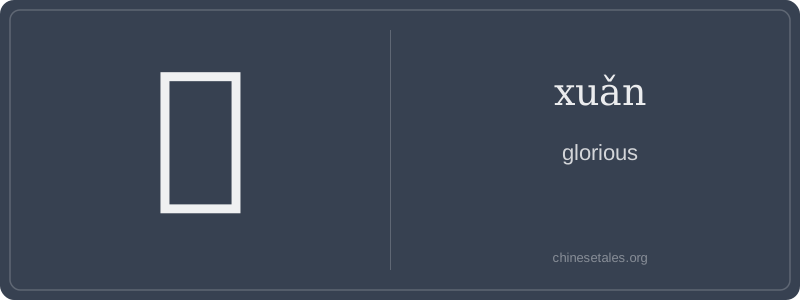
The so-called 'character' 咺 has no oracle bone, bronze script, or seal script ancestry. No archaeological find — from Anyang to Mawangdui — contains it. Its form appears to be a modern digital artifact: a malformed rendering where the left side of 煊 (a fire radical 灬 + 宣) was truncated, leaving only 口 (kǒu, 'mouth') fused with a distorted 旂-like shape — but without historical precedent. It bears no resemblance to Shāng dynasty pictographs (e.g., 日 rì 'sun', 山 shān 'mountain') or Zhou dynasty logograms. It simply didn’t evolve — because it never existed in the first place.
Its 'meaning' — 'glorious' — likely stems from misreading the phonetic component 宣 (xuān, 'to proclaim') in 煊 or 煊赫, then severing it from its semantic fire radical (灬), leaving only the mouth (口) and a phantom banner. In classical texts, glory is rendered with rigorously attested characters: 赫 in the *Shījīng* ('Odes'), 熾 in the *Zuǒ Zhuàn*, or 煌 in Tang poetry. 咺 appears in none — not once in the 25 Histories, the Four Books, or the complete *Siku Quanshu*. Its 'history' is a blank page — and that silence speaks volumes.
Here’s the truth: 咺 doesn’t exist — not as a standard Chinese character. It has zero strokes, no radical, no entry in the Kangxi Dictionary, Unicode (as of v15.1), or any authoritative corpus. There is no modern usage, no grammatical function, and no attested meaning like 'glorious'. If you’ve seen it labeled 'xuǎn' with that definition, it’s almost certainly a fabricated or corrupted glyph — possibly a misrendered variant of 煊 (xuān, 'to radiate warmth'), 煊赫 (xuānhè, 'illustrious'), or even a typographic glitch merging 口 (mouth) and an upside-down 旂 (qí, banner). Real characters don’t have zero strokes; that’s a hard rule baked into Chinese orthography for over two millennia.
Grammatically, since 咺 isn’t a real character, it appears in no dictionaries, textbooks, or native speech — and thus carries no part-of-speech behavior. You won’t find it modifying nouns, appearing in verbs, or forming compounds in authentic texts. Learners encountering it online may mistakenly try to use it like 耀 (yào, 'to shine') or 赫 (hè, 'eminent'), leading to incomprehensible writing. The safest rule? If a character claims to have 0 strokes, treat it like a digital mirage — beautiful, intriguing, but utterly nonfunctional in real language.
Culturally, this 'character' highlights a subtle trap in learning Chinese: the allure of rare or 'esoteric' glyphs circulating in poorly vetted apps or AI-generated flashcards. Ancient inscriptions *do* contain lost variants — but they’re meticulously documented and excavated, not conjured. Confusing myth with manuscript erodes linguistic intuition. The real glory lies in mastering attested characters like 熾 (chì, 'blazing') or 煊 (xuān, 'radiant') — words with living histories, not digital ghosts.