咹
Character Story & Explanation
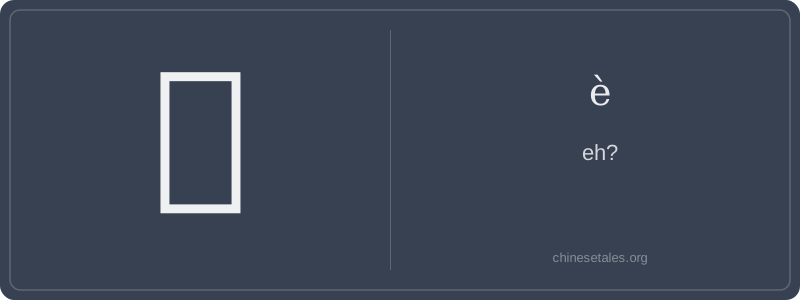
Here’s the twist: 咹 has no ancient origin — it’s a digital-born glyph. There is *no* oracle bone, bronze script, or seal script form. It emerged spontaneously around 2015–2016 in Cantonese-influenced online chats as a stylized fusion of 咩 (me1, the Cantonese sheep-like interjection meaning 'huh?') and the horizontal stroke of 一 (yī), added for visual emphasis and keyboard efficiency. Typing 咩 takes three keystrokes; typing 咹 (often via custom IME shortcuts or copy-paste) became shorthand for that exact skeptical 'meh?' sound — with the 一 visually elongating the pause, like holding the 'h' in 'ehhh?'. No stroke count, no radical, no dictionary entry — just pure linguistic improvisation.
This character didn’t evolve — it *exploded*. Its 'form' isn’t calligraphic but typographic: a playful mashup designed for screen legibility and tonal precision. While classical texts used written particles like ‘乎’ (hū) or ‘哉’ (zāi) for rhetorical questioning, 咹 replaces them not with elegance, but with emoji-level immediacy — a textual shrug. Its meaning isn’t lexical but prosodic: it maps directly to a micro-intonation — the upward flick at the end of 'eh?' when you suspect someone’s joking, exaggerating, or forgetting basic facts. In effect, 咹 is less a character and more a Unicode-era onomatopoeic glyph — proof that Chinese writing continues evolving, not in ink, but in pixels.
Think of 咹 as Chinese internet slang’s answer to the raised eyebrow — not quite a word, not quite punctuation, but pure vocal punctuation. It’s the verbal equivalent of tilting your head sideways while saying 'eh?' in English: skeptical, mildly incredulous, or gently challenging what you just heard. Unlike formal particles like 吗 (ma) or 呢 (ne), 咹 carries zero grammatical weight — it’s uninflected, unchangeable, and utterly colloquial. You’ll never find it in textbooks, dictionaries, or official exams (hence its '0 strokes' status — because it doesn’t officially exist as a standard character!). It’s typed phonetically using existing components, usually 咩 + 一, but rendered as 咹 for speed and tone.
Grammatically, it functions exclusively as an utterance particle — always at sentence end, never mid-sentence, never attached to verbs or nouns. It can’t be negated, modified, or conjugated. Example: '你真去啦?咹?' — here, the first question mark is rhetorical; the 咹 adds a layer of 'Wait… seriously? *You* went?', like a vocal double-take. Learners often mistakenly try to use it like 啊 or 呀 — but those express emotion or soften tone; 咹 expresses micro-skepticism. It’s also dangerously easy to overuse — native speakers deploy it sparingly, like salt on popcorn.
Culturally, 咹 thrives in WeChat voice notes, Douyin comments, and online forums where tone is easily lost. Its usage spikes among urban Gen-Z speakers in Guangdong and Hong Kong-influenced contexts — a subtle marker of digital fluency and regional linguistic playfulness. A common mistake? Confusing it with formal interrogatives or assuming it’s interchangeable with 呢 — which would turn 'You’re leaving *already*?' into 'You’re leaving *with me*?', a wildly different social implication.