咯
Character Story & Explanation
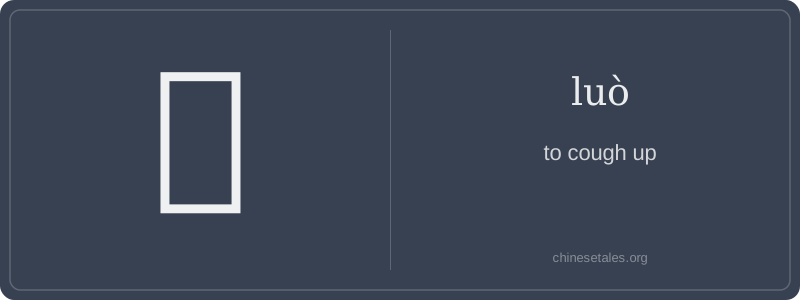
The earliest form of 咯 appears in Han dynasty clerical script, not oracle bone — because it’s a later semantic-phonetic compound. It combines 口 (kǒu, ‘mouth’, the semantic radical hinting at oral expulsion) and 各 (gè, ‘each’, here serving as the phonetic component, pronounced similarly in ancient Chinese: *lak* → *luò*). Visually, the left 口 is compact and upright, while the right 各 unfurls with its distinctive ‘geometric’ top (夂, ‘to go’) over 口 — suggesting movement *outward* and *downward* (the 夂 stroke), then *upward* again (the dot and horizontal) — mirroring the physical path of phlegm rising through the throat. The nine strokes lock this action into place: 3 for 口, 6 for 各 — a perfect kinetic balance.
Meaning-wise, 咯 emerged during the Han–Tang transition as medical understanding of ‘phlegm-dampness’ (a key concept in Traditional Chinese Medicine) deepened. Classical texts used it to denote the active expulsion of pathological fluids — not just any secretion, but one tied to internal imbalance. By the Ming dynasty, it appears in vernacular novels like *Jin Ping Mei*, where characters ‘咯痰’ (luò tán, cough up phlegm) during fevers or emotional distress, linking bodily function to moral or spiritual state. The character’s visual tension — mouth + ‘going’ — captures this duality: a physiological act charged with diagnostic and narrative significance.
Imagine hearing a sharp, wet, throat-clearing sound — not quite a cough, not quite a gag, but that visceral, involuntary *lùo* as something thick and stubborn rises up from deep in the chest. That’s 咯 (luò) — a character that doesn’t describe illness, but the very physical *act* of expelling phlegm or mucus *upward and out*, often with effort. It’s intensely bodily, almost onomatopoeic: the ‘luò’ sound mimics the guttural release, and the 口 (mouth) radical anchors it firmly in vocal/physical expression — this isn’t abstract; it’s something you *do*, and sometimes *hear*.
Grammatically, 咯 is almost always a verb, used transitively (‘to cough up X’) or intransitively (‘to cough up’), and it carries a slightly clinical or descriptive weight — you’ll see it in medical reports, literature depicting illness, or blunt colloquial speech. Learners often mistakenly use it like 咳 (ké, ‘to cough’) or 吐 (tǔ, ‘to spit/vomit’), but 咯 is narrower: it specifies *phlegm/mucus* moving *upward* through the airway. You wouldn’t ‘咯’ food (that’s 吐) or just air (that’s 咳). Also beware tone: luò (4th) is *not* the same as lo (light tone, used as a sentence-final particle) — mixing them changes meaning entirely.
Culturally, 咯 appears in classical medical texts like the *Huangdi Neijing* describing pathological ‘phlegm uprising’, and in modern fiction to signal real physical distress — think of a character in a novel ‘咯出一口血痰’ (coughing up blood-tinged phlegm), instantly conveying severity. Its rarity in daily speech (hence no HSK listing) makes it feel precise, even literary — using it correctly signals nuanced command of descriptive vocabulary, not just survival phrases.