咮
Character Story & Explanation
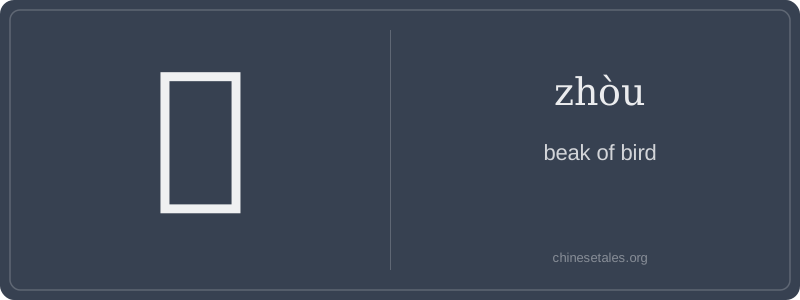
The earliest form of 咮 appears in bronze inscriptions as a stylized pictograph: a bold, downward-curving line representing the upper mandible, with a small dot or stroke beneath hinting at the lower jaw — like a hawk’s profile caught mid-dive. Over centuries, this simplified: the curve became the top component (the ‘mouth’ radical 口), while the lower part evolved into the phonetic element 狩 (shòu), which originally meant ‘to hunt’ — perhaps because birds of prey use their beaks as hunting tools. By the Han dynasty, the character stabilized into its current shape: 口 + 狩 — mouth + hunt — visually encoding both function and sound.
This semantic-phonetic fusion deepened its literary resonance. In the Shijing (Book of Odes), 咮 appears in descriptions of phoenixes, symbolizing clarity and divine communication — their beaks ‘uttering auspicious sounds’. Later, Tang poets used it to contrast fragility and strength: ‘The swallow’s 咮 is tiny, yet builds a palace of mud.’ Visually, the 口 radical isn’t generic — it’s tightly bound to the phonetic, making the whole character feel like a compact, self-contained image: a mouth that hunts, a mouth that defines a bird’s essence.
Imagine a bird’s beak — not just as anatomy, but as a vivid, almost aggressive focal point: sharp, precise, purposeful. That’s 咮 (zhòu) in spirit. It’s not a casual or poetic word like 嘴 (zuǐ, 'mouth') or 口 (kǒu, 'opening'); it’s literary, classical, and zoomed-in — evoking the hard, keratinous tip that pierces air, cracks seeds, or grips twigs. You’ll rarely hear it in daily speech; it lives in poetry, ornithological texts, and classical allusions — think of Du Fu describing cranes ‘lifting their 咮 toward the clouds’. Its feel is elegant, slightly archaic, and unapologetically avian.
Grammatically, 咮 functions exclusively as a noun — always ‘beak’, never verb or modifier. Unlike 嘴, it cannot mean ‘mouth’ metaphorically (no ‘a mouthful of words’ here!), nor does it combine freely with measure words like 一隻 (yī zhī). Instead, it appears with literary classifiers like 一喙 (yī huì) or in fixed compounds like 鳥咮 (niǎo zhòu). Learners often mistakenly substitute it for 嘴 in modern contexts — a subtle but jarring anachronism, like quoting Shakespeare mid-text-message.
Culturally, 咮 carries a quiet dignity: in classical painting inscriptions, it’s used to praise a bird’s ‘graceful 咮’ — implying precision and natural artistry. A common trap? Confusing its pronunciation: zhòu rhymes with ‘joke’ (not ‘zho’ or ‘zhou’), and its tone is fourth — sharp and falling, like a heron snapping shut. Also, it’s never used for human mouths, insect mandibles, or machine nozzles — those are all different characters entirely.