咫
Character Story & Explanation
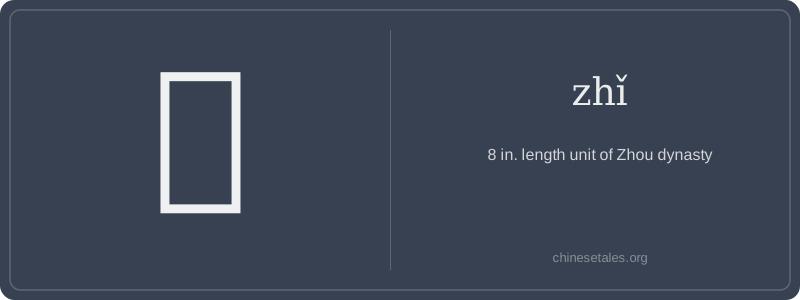
The earliest form of 咫 appears on Western Zhou bronze inscriptions as a stylized hand gesture: a vertical line (representing the forearm), topped by three short horizontal strokes (fingers splayed), plus a small square-like shape near the base—later evolving into the 口 radical. Over centuries, the top simplified into the 矢 component (arrow-shaped, suggesting direction and precision), while the 口 anchored it to human scale. By the Qin seal script, the nine-stroke structure stabilized: 口 (mouth/human reference) + 矢 (arrow/focus), visually encoding 'a measured span defined by the human body.'
This character crystallized in the Rites of Zhou (Zhou Li), where 咫 was formally defined as half a 尺 (chǐ), itself based on the ruler’s forearm. Classical poets seized its evocative power: Du Fu wrote of '咫尺不见老父面' ('within a handspan, yet I cannot see my aging father’s face'), using physical proximity to underscore emotional distance. The 口 isn’t about speaking—it’s the mouth’s width as an ancient calibration tool, making 咫 a rare character where anatomy became arithmetic.
Think of 咫 (zhǐ) as China’s ancient ‘handspan’ — like the British imperial unit ‘foot’, but even more personal: it was literally the distance from the tip of your thumb to the tip of your little finger when your hand is spread wide, standardized at about 8 inches during the Zhou dynasty. Unlike modern metric units, 咫 wasn’t abstract science—it carried tactile intimacy, measuring things close enough to hold or touch: a child’s reach, a whisper’s range, the span of a ritual bronze vessel’s rim.
Grammatically, 咫 almost never stands alone in speech today; it lives exclusively in fixed literary compounds like 咫尺 (zhǐ chǐ, 'a handspan’s distance') or 咫尺天涯 (zhǐ chǐ tiān yá, 'heaven and earth in one handspan'). You’ll never say *'This table is three 咫 long'*—that would sound archaic and jarring, like saying 'three furlongs' in casual English. Instead, it functions like the word 'whisker' in 'a whisker away'—poetic, idiomatic, and always metaphorical.
Learners often misread 咫 as a measurement noun they can plug into sentences like 米 or 厘米—but no: it’s fossilized in classical rhythm and imagery. Its radical 口 (mouth) hints at its original link to human scale—not voice, but the mouth’s width as a body-based unit (early texts describe it as 'the width of a man’s mouth'). Confusing it with similar-looking characters like 尺 or 易 is common—and fatal for tone and meaning.