咪
Character Story & Explanation
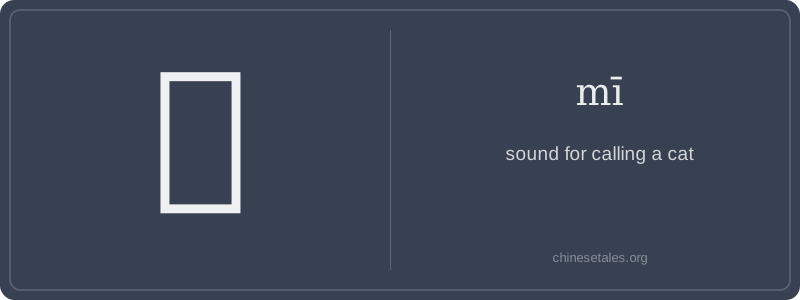
The earliest form of 咪 doesn’t appear in oracle bone inscriptions — it’s a latecomer, born from phonetic borrowing during the late imperial period. Its structure is beautifully transparent: left side 口 (kǒu, 'mouth') signals it’s a vocalization; right side 米 (mǐ, 'rice') serves purely as a phonetic hint — both characters share the same initial 'm-' and similar vowel resonance. Over time, 米’s strokes simplified: the original 米 had eight strokes with distinct rice-grain dots, but in 咪, it became a clean, compact 6-stroke component with flattened horizontal strokes and a final downward hook — optimized for speed and clarity in everyday handwriting.
By the Qing dynasty, 咪 emerged in vernacular fiction and nursery rhymes as the go-to written representation for the cat-call sound — chosen precisely because 米 sounded close enough to the drawn-out, breathy 'mī' people actually made. Classical texts never used it; it’s a folk innovation, proof that Chinese writing evolves from real-life sounds, not just ancient ritual. Its visual rhythm — small mouth + familiar food symbol — subtly suggests comfort and familiarity, reinforcing why it feels so tender and domestic today.
Think of 咪 (mī) as Chinese onomatopoeia’s playful whisper — it’s not a formal word, but the soft, affectionate 'meow' you make when coaxing a cat: a gentle, slightly nasal 'mī~' with a rising tone. Unlike English 'meow', which is sharp and open-mouthed, 咪 is mouth-closed, lips lightly parted — fitting perfectly with its 口 (mouth) radical. It’s not a verb or noun by itself; it almost always appears as an interjection or reduplicated for charm: 咪咪 (mī mī), like calling 'Kitty-kitty!' while patting your lap.
Grammatically, 咪 rarely stands alone in writing — you’ll see it in casual speech, children’s books, pet-care apps, or social media captions ('快看!小猫在叫咪咪~'). It’s never used in formal writing or exams (hence not in HSK), and learners shouldn’t try to conjugate it — no 咪了, no 咪过. A common mistake? Using it like a noun meaning 'cat' — that’s wrong! While 咪咪 *can* colloquially mean 'kitty' (like 'my little mī mī'), the bare character 咪 alone only represents the sound — not the animal.
Culturally, 咪 carries warmth and intimacy — it’s the sound of nurturing, playfulness, or gentle command. Parents use it to soothe babies ('咪~别哭'), and pet owners coo it like a lullaby. Interestingly, in some southern dialects (e.g., Cantonese), 咪 also means 'not' — but that’s a homophone coincidence, unrelated to this character’s origin or Mandarin usage. Don’t mix them up!