咩
Character Story & Explanation
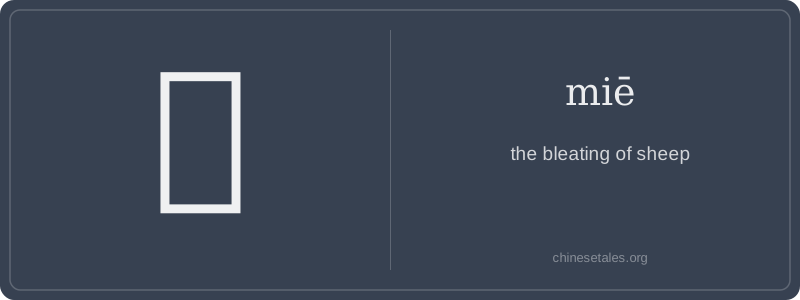
The earliest form of 咩 appears not in oracle bones, but in late clerical script (c. 2nd century BCE), where scribes cleverly fused two existing characters: 口 (kǒu, 'mouth') on the left — drawn as a simple square with a dot inside — and 羊 (yáng, 'sheep') on the right, originally a pictograph of horns, eyes, and beard. Over centuries, 羊 simplified from a detailed head profile to its modern top-heavy shape (⺶ + three horizontal strokes), while 口 retained its compact, mouth-like frame — together forming a visual pun: ‘mouth + sheep = the sound sheep make.’ No ancient bronze inscription bears 咩 alone; it emerged organically as Chinese writing evolved toward phonetic-semantic compounds.
By the Tang dynasty, 咩 appeared in poetry and folk texts not as literal livestock notation, but as expressive vocalization — Li Bai’s disciples reportedly used it in playful marginalia to mimic pastoral scenes. In Ming vernacular fiction, it gained emotional nuance: a single 咩 could signal feigned innocence or coy deflection. Its visual duality — mouth open, sheep present — cemented its role as a ‘sound-carrier’ rather than a ‘thing-carrier,’ distinguishing it from purely semantic characters. Even today, seeing 咩 instantly triggers auditory imagery: not just *what* sheep do, but *how* their voice lands in human ears — soft, repetitive, slightly absurd.
Think of 咩 (miē) as Chinese onomatopoeia’s answer to 'baa' — but with more personality and a dash of theatrical flair. It doesn’t just *represent* sheep sound; it *performs* it: the mouth radical 口 literally opens wide, while the right side (羊, yáng, 'sheep') tells you *whose* voice this is — like a stage direction written into the character itself. Unlike English ‘baa’, which stays neutral, 咩 in Chinese often carries tone and attitude: playful, mocking, or even sarcastic — imagine a teenager saying 'miē~?' with exaggerated doubt, eyebrows raised.
Grammatically, 咩 almost never stands alone as a verb ('to bleat'); instead, it’s used as an interjection or sentence-final particle for expressive effect — much like English ‘huh?’, ‘really?’, or ‘oh *please*’ delivered with a sheepish shrug. You’ll hear it in dialogue: ‘Nǐ shuō shénme? Miē?’ (‘What did you say? *Baa?*’), where it signals disbelief wrapped in gentle teasing. Learners mistakenly try to use it as a noun ('the bleat') or verb — but native speakers don’t say ‘tā miē le’ (‘he bleated’) — they’d use 叫 (jiào) or 吠 (fèi, for dogs) instead.
Culturally, 咩 is a linguistic pet — cute, non-threatening, and deeply embedded in internet slang and children’s media. It’s common in cartoon speech bubbles, WeChat stickers (a sheep emoji + 咩), and viral memes where users mock overly earnest statements with ‘Miē… nǐ dāng zhēn de ma?’ (‘Baa… you serious?’). A classic mistake? Confusing it with 羊 (yáng) — forgetting the 口 means it’s not about the animal, but its *voice*. And yes — despite nine strokes, it’s rarely tested because it’s more flavor than function.